
History and the
Spanish Civil War
Fan
Spanish Civil War - Historical Overview
SPANISH CIVIL WAR (1936-1939)
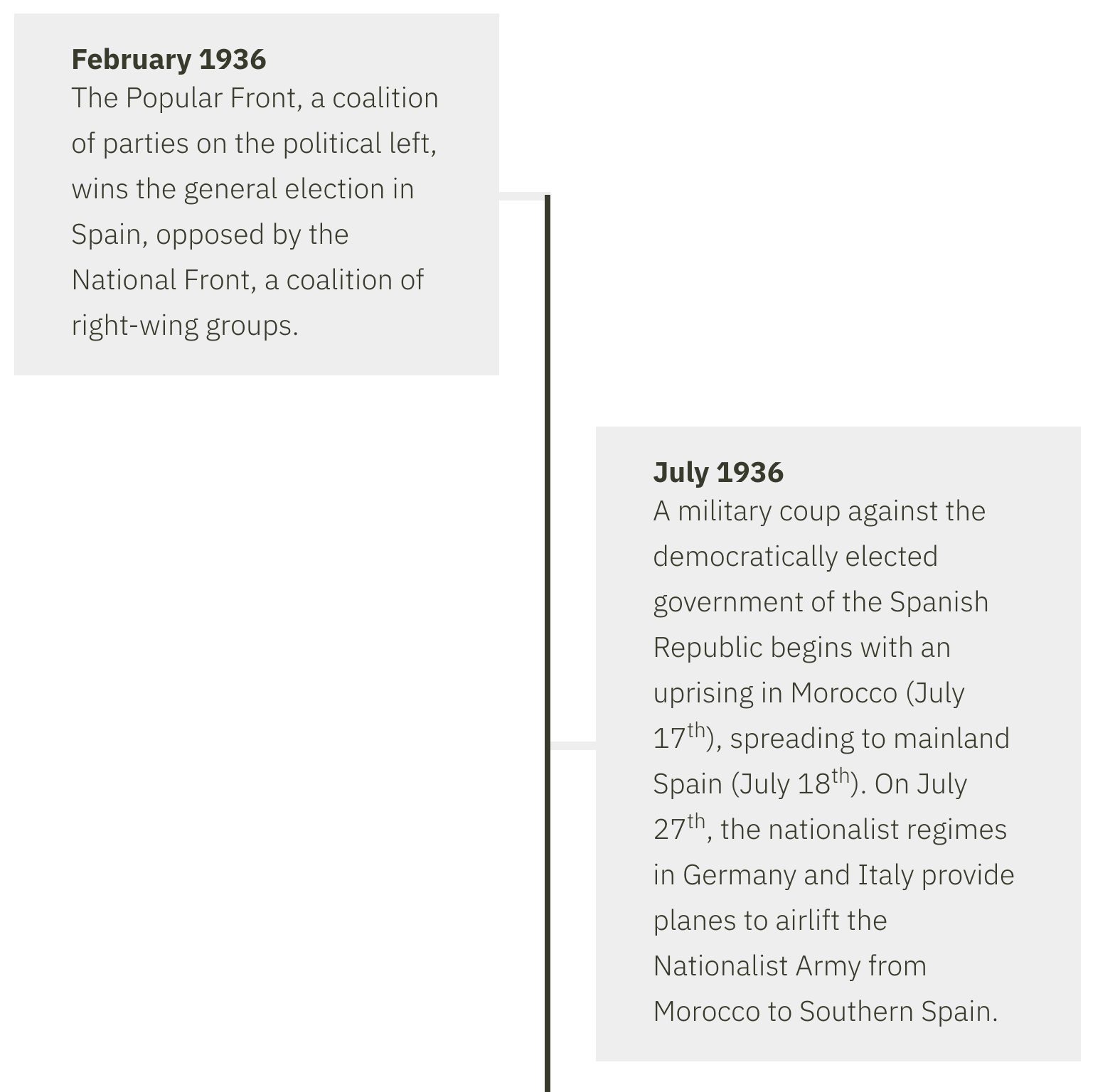
The Spanish Civil War began on July 17-18, 1936 as a military coup against the government of the Spanish Republic. While initially a domestic Spanish affair, it soon became an international conflict. Nazi Germany (Hitler) and Fascist Italy (Mussolini) aided Franco’s Nationalists, while the Soviet Union (Stalin) supported the Spanish Republican government through the Popular Front alliance. Defying the policy of neutrality and non-intervention adopted by the western democracies, over 35,000 international volunteers joined the Republican forces as members of the International Brigades. Around 2,800 of these volunteers came from the United States.
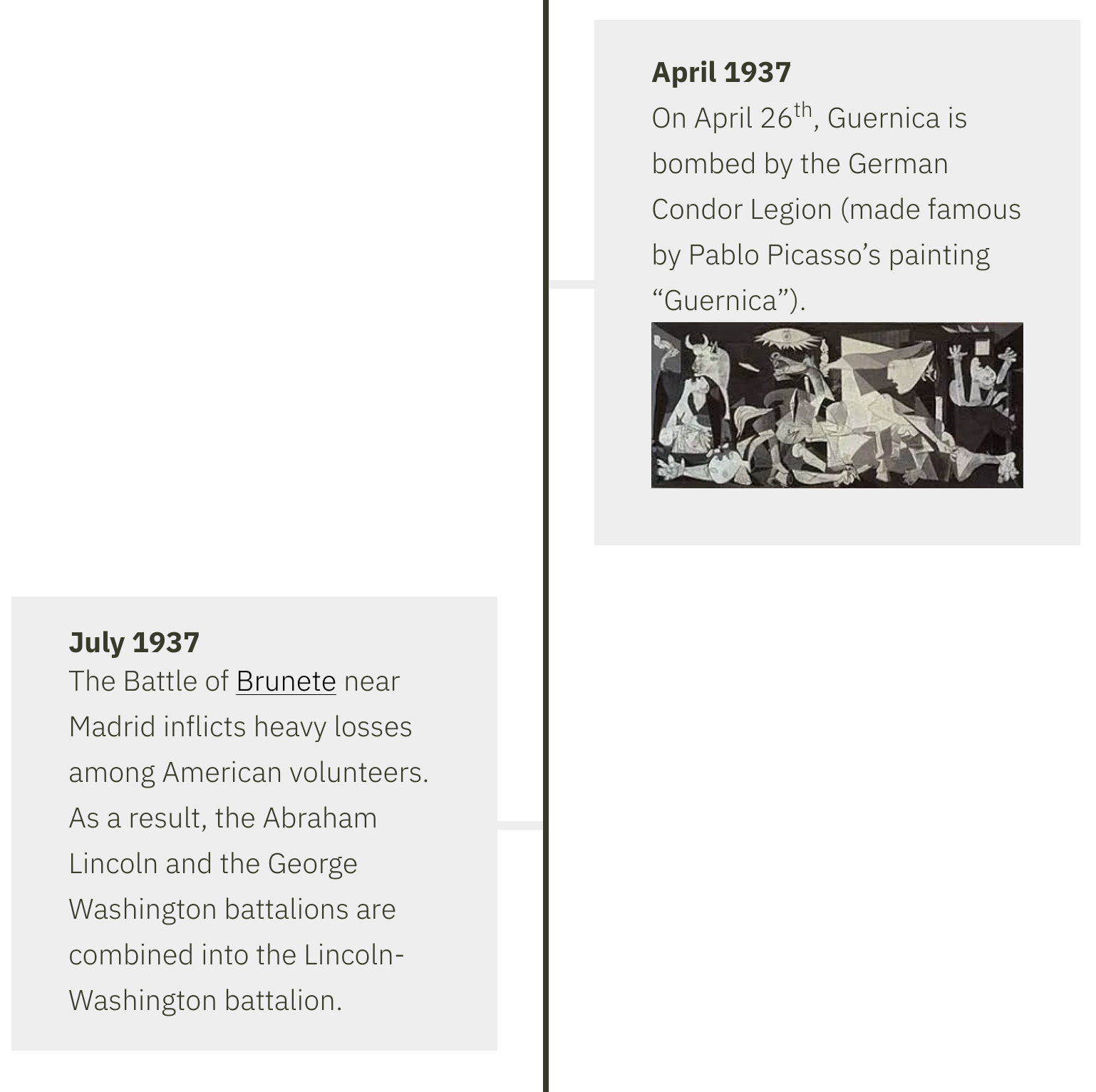
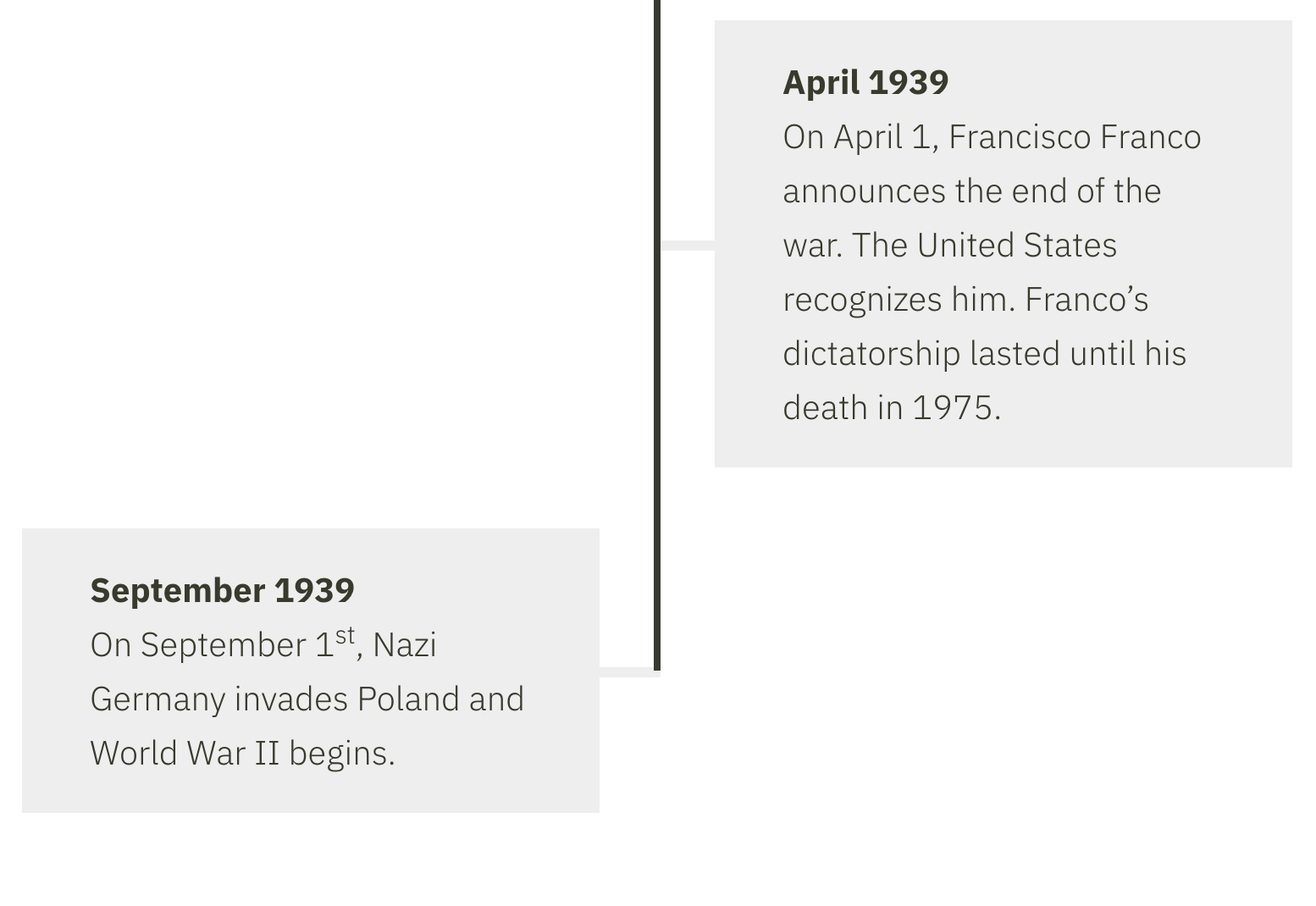
The conflict in Spain served as a training ground for some of the military tactics that would become prevalent in World War II. Among them was the aerial attack of cities, immortalized by Pablo Picasso’s painting of the bombing of the Spanish town of Guernica by the Nazi German Condor Legion in 1937. On April 1, 1939, a victorious General Franco declared the end of the war. The war claimed the lives of about 350,000 Spaniards and forced another half a million into exile. Thousands more would die in the postwar repression established by the Franco regime (1939-1975).
Common Definitions and additional Information:
Nationalists:
Supporters of the military uprising against the Second Republic. They represented conservative and right-wing forces, including the Falange (Spanish Fascist Party), Carlists (ultraconservative monarchists), the Catholic Church and sections of the army. In 1937, Franco merged these groups into a single Falangist party that came to be known as el Movimiento (The Movement).
Forging a Dictatorship in Spain
Republicans:
Supporters of the Spanish Republic. They represented progressive and left-wing forces, including anarchists, communists, socialists, labor unions, and those defining themselves broadly as anti-fascists.
Francisco Franco Bahamonde (1892-1975):
Spanish general. Franco began his military career in Spanish Morocco. By 1926 he was the youngest general in Spain. In 1936, Franco joined the military uprising against the Spanish Republic, leading the rebellion in Morocco. Hitler and Mussolini helped Franco transport the Army of Africa from Morocco to the Iberian Peninsula. During the Spanish Civil War, Franco would continue to receive substantial military aid from both Germany and Italy. Franco became the leader of the Nationalist forces. After their victory in the Spanish Civil War, he established a dictatorship that lasted until his death in 1975.
Juan Negrín López (1892-1956):
Leader of the Spanish Socialist Workers’ Party (PSOE). Negrín was Prime Minister of the Spanish Republic from May 1937 until the end of the war in March 1939. After the fall of the Republic, he fled to France. He continued to serve as Prime Minister of the Spanish Republican government in exile until 1945. He died in Paris in 1956.
Timeline
Maps
A map of all the International Volunteers of the 129th Brigade who signed the fan. This includes the International Volunteers from the United States, Canada, and the United Kingdom.
Click the box in the top left of the map window for a legend explaining what the pins mean.
International Brigades
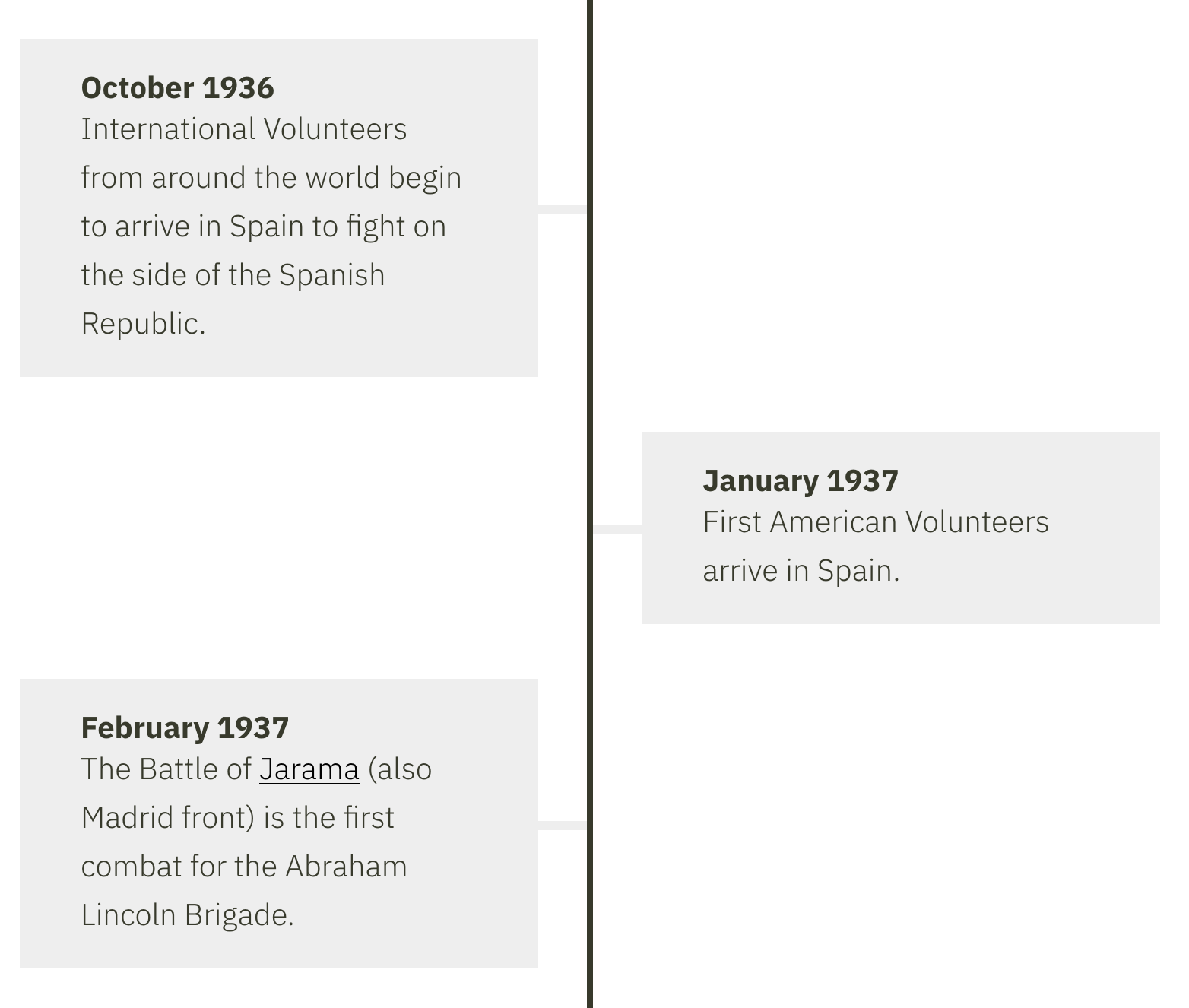
The International Brigades consisted of a number of military units formed in 1936 by the Communist International (Comintern) to defend the democratically elected Spanish Republic against the violent uprising of Franco’s Nationalists. With the assistance of the Popular Front (Frente Popular), a coalition of international groups determined to fight fascism in Europe, the International Brigades’ volunteers entered Spanish territory in October, 1936. About 35,000 volunteers representing 80 nationalities fought in the Spanish Civil War, among them where about 2,500 US Americans, 1,800 British, 500 Canadians. A total of five International Brigade units were formed, from the 11th to the 15th brigades.
The 31 men who signed the fan belonged to the 15th Brigade and consisted of volunteers from the United States, the United Kingdom, and Canada.
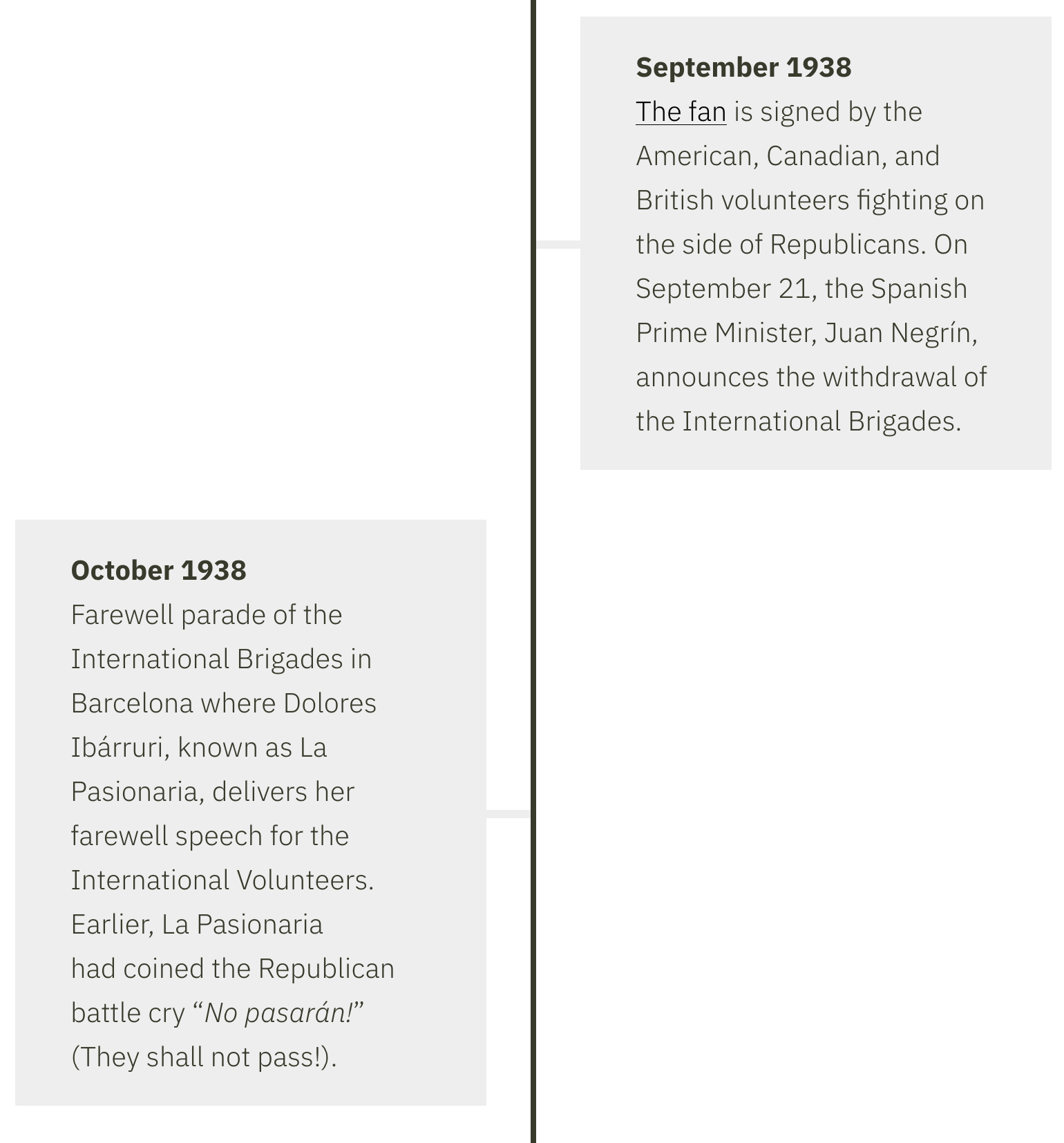
For two years, the International Brigades fought against the Spanish Nationalists, including in the major battles of Jarama, Brunete, Teruel, and the Ebro. On September 21, 1938, the Spanish Prime Minister, Juan Negrín, announced the official departure of the International Brigades. It was Negrín’s final diplomatic effort to force Franco’s Nationalists to turn down the military support they received from fascist Italy and Nazi Germany. This, however, did not happen and it sealed the military defeat of the Spanish Republic.
On October 28, a farewell parade for the international volunteers took place in Barcelona, where Dolores Ibarruri, a Spanish Communist known as La Pasionaria (the passion flower), delivered an impassioned speech to thank the volunteers. About one-third of the American volunteers lost their lives in the war; there was scarcely a volunteer who left without wounds or without having suffered from hunger and sickness.
Further Information:
Encyclopedia of Marxism. “Popular Front.”
Marxist Internet Archive. “The Communist International.”
XV International Brigade in Spain
Michael Curtis. “The Return of the International Brigade.” NewEnglish Review. 22 March 2022.
Structure of the Brigades
A brigade is a military unit that consists of three to six battalions. In total, this translates to about 3,000 personnel in a brigade. A battalion is a military unit that consists of 300 to 1,000 personnel in total. Battalions consist of four to six companies. The International Brigades usually organized battalions based on shared nationality and language among its volunteers. The 15th Brigade had six battalions, and each battalion had four companies. It included several English-speaking battalions (American, Canadian, Irish, and British). Political commissars were present on all levels of organization—brigades, battalions, and companies. They were tasked with the instruction of communist ideology and the enforcement of military and political discipline. How these objectives were approached varied greatly among the individual commissars.
Further Information:
Chris Brooks. “Jarama Series. The Regiments. The Volunteer. 13 July 2016.
Abraham Lincoln Brigade (Battalion)
The Abraham Lincoln Brigade (Battalion) was part of the 15th International Brigade, formed in January 1937. The name paid homage to the American President, Abraham Lincoln, known for his role in the American Civil War. Several people, like historian Peter Carroll, suggest that the name emphasized the connections between the American Civil War and the Spanish Civil War. It was meant to inspire American volunteers to fight in Spain against Franco’s troops.
While this unit is frequently referred to as the Abraham Lincoln “Brigade”— by the volunteers themselves as well as in the literature and in this project—the technically correct name for this military unit made up of volunteers from the United States is the Abraham Lincoln “Battalion.” It should be noted that some American volunteers insisted on calling the unit a “battalion.” For example, Bob Merriman, the American commander of the Abraham Lincoln Battalion, saluted it in his diary with, “Long Live the Lincoln Battalion.”
This project, however, follows the widely accepted terminology of the Abraham Lincoln Brigade as the more inclusive term for all the units in which American volunteers served, such as the Medical Bureau and later the Washington Battalion, after it had merged with the Abraham Lincoln Battalion.
Further Information:
David Jorge and Sebastiaan Faber. “Naming the Lincoln Battalion.” The Volunteer. 13 March 2016.
William Loren Katz. “The Forgotten Fight Against Fascism.” Zinn Education Project. 10 June 2014.
George Washington Battalion
The George Washington Battalion consisted of American volunteers—with the exception of its leader, Mirko Markovics, a volunteer from Yugoslavia. It was formed in late April 1937 after the battles of Jarama, Malaga and Guadalajara. Markovics was instructed to organize a second English-speaking unit, distinct from the Lincoln Battalion. The Washington Battalion operated under the 15th International Brigade and was majorly involved in the battle of Brunete in the summer of 1937. After Brunete, where it was nearly destroyed, this unit was disbanded and its members transferred to the Abraham Lincoln Battalion.
Further Information:
Chris Brooks. “The making of the Washington Battalion.” TheVolunteer. 21 March 2014.
Lincoln-Washington Battalion
Before the Battle of Brunete, International forces trained a new Washington Battalion to help support the Lincoln Battalion, especially after the Lincoln Battalion’s recent battle at Jarama. At the battle of Brunete in July 1937, the 15th International Brigade launched an attack on Mosquito ridge, a key point at the battle of Brunete. Despite repeated assaults, the 15th Brigade was unable to take control of the ridge, suffering heavy casualties. As a result, the Lincoln and Washington Battalions were merged and became known as the Lincoln-Washington Battalion – though it was still often referred to as the Lincoln Battalion.
Further Information:
Anna Martí. “In the footsteps of the Lincoln-Washington Battalion.” The Volunteer. 1 July 2012.
Thälmann Battalion
Many anti-fascist Germans who had escaped Nazi Germany were recruited by the German Communist Party to join the fight in Spain. They formed the Thälmann Battalion, named after the leader of the German Communist Party, Ernst Thälmann. The so-called “Thälmann Brigade” was the unofficial name for the 11th International Brigade. Formally, it consisted of the Thälmann Battalion, the Edgar Andre Battalion, and the Hans Beimler Battalion. It included volunteers of Swiss, Dutch, Austrian, German, and Scandinavian origin. The Thälmann Battalion was present in November 1936 during the battle of Madrid and later participated in the battle of Guadalajara. An estimated 3,000 Germans volunteered with the International Brigades, though not all joined the Thälmann Battalion.
Further Information:
Victor Grossman. “The Last German Volunteer.” The Volunteer. 4 March 2011.
John Simkin. “Thaelmann Battalion.” Spartacus-educational.
Mackenzie-Papineau Battalion
The Mackenzie-Papineau Battalion was formed as an expansion to the 15th Brigade in the summer of 1937 after the Anglo-American battalions—that included Canadians—had faced heavy casualties in the two-week battle of Brunete. Its name came from William Lyon Mackenzie and Louis-Joseph Papineau, who had advocated for Canada’s home rule in the early nineteenth century. In 1837, Mackenzie and Papineau had waged their own anti-colonial uprisings in Canada. Nicknamed the “Mac-Paps,” approximately 1,500 Canadian volunteers fought in the Spanish Civil War.
Initially, the Mackenzie-Papineau Battalion was an English-speaking unit of a roughly equal number of Canadians and U.S. Americans. It came to be viewed as uniquely Canadian when its Canadian contingent significantly increased. Like their fellow American volunteers, many Canadians fought in Spain because of their connections to the Communist Party of Canada and, more broadly, their commitments to antifascism. The Mac-Paps were chiefly involved in the battles of Brunete, Teruel, Gandesa, and the Ebro. About half of the volunteers in the Mackenzie-Papineau Battalion lost their lives.
Further Information:
Chris Brooks. “Jarama Series; Canadians in the Lincoln Battalion.” The Volunteer. 15 June 2016.
129th Brigade
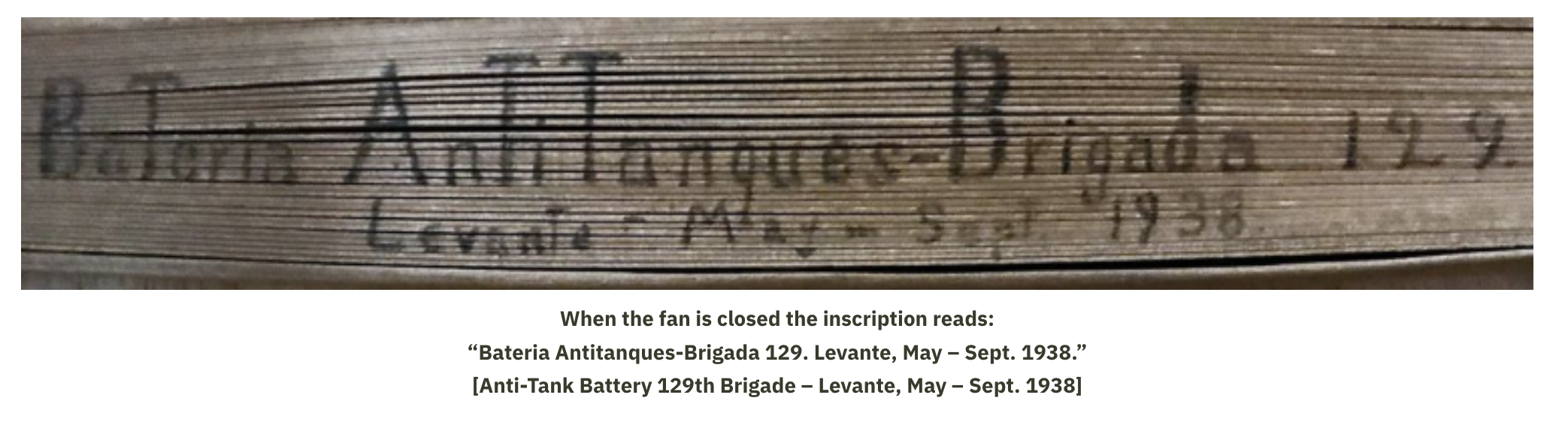
The 129th International Brigade included members of different countries and was also known as the 129th Mixed Brigade of “Forty Nations Brigade.” The 129th Brigade was the last International Brigade to be formed. Its name is written on the fan, along with the names of the men who signed it. Our project focuses on the experiences of the men that were part of the 129th Brigade anti-tank battery.
Many of these men had been part of the 35th Anglo-American Battery of the 4th Artillery Group under the command of Nathan Budish, with Sidney (“Sid”) Kaufman as its political commissar. Budish had previous experience in the U.S. National Guard. The 35th Battery was one of the international units left in the southern portion of the Republican territory, which the Nationalists had cut in half after reaching the Mediterranean coast in April 1938. The majority of the International Brigades were in the northern half, closer to the French border.
In June 1938, the 35th battery was ordered to merge with another brigade—the Dimitroff—to form what would be called the 129th Brigade. In the fall of 1938, the 129th Brigade withdrew to the city of Valencia. In January 1939, they were transported to Barcelona by boat and from there by train to the village of Cassà de la Selva, where Americans from the 15th Brigade regrouped. The American volunteers from the 129th Brigade joined them, effectively dissolving it as a separate entity.
The former editor of the journal, The Volunteer, Ben Iceland, himself an artillery member of this unit, crafted detailed records of the 129th Brigade, including information about Maurice Hawkins and Frank Madigan. The 35th battery’s political commissar, Sidney Kaufman, also wrote about other signatories of the fan, notably on how John Palu and John Stuivenberg returned to the United States.
Further Information:
Chris Brooks and Liana Katz. “Blast from the Past: Artillery Series. The Volunteer. 7 July 2015.
Chris Brooks. “The Flight by Sidney Kaufman.” The Volunteer. 10 April 2020.
Diversity among American Volunteers
About 70% of the Americans who volunteered in the Spanish Civil War were recent immigrants or their descendants, especially from Europe. Among them we find people from Estonia, Germany, Spain, Lithuania, The Netherlands, and Armenia as well as Jewish and Black Americans (see also our statistics). They had strong alliances with labor and leftist movements in the United States and understood the danger of the rise of fascism in Europe. For them, fascism was an issue of international importance. The American volunteers, like those from other countries, were internationalists at heart. The Abraham Lincoln Brigade was the first racially integrated military unit in U.S. history, including a mixed unit led, for the first time, by a black commander.
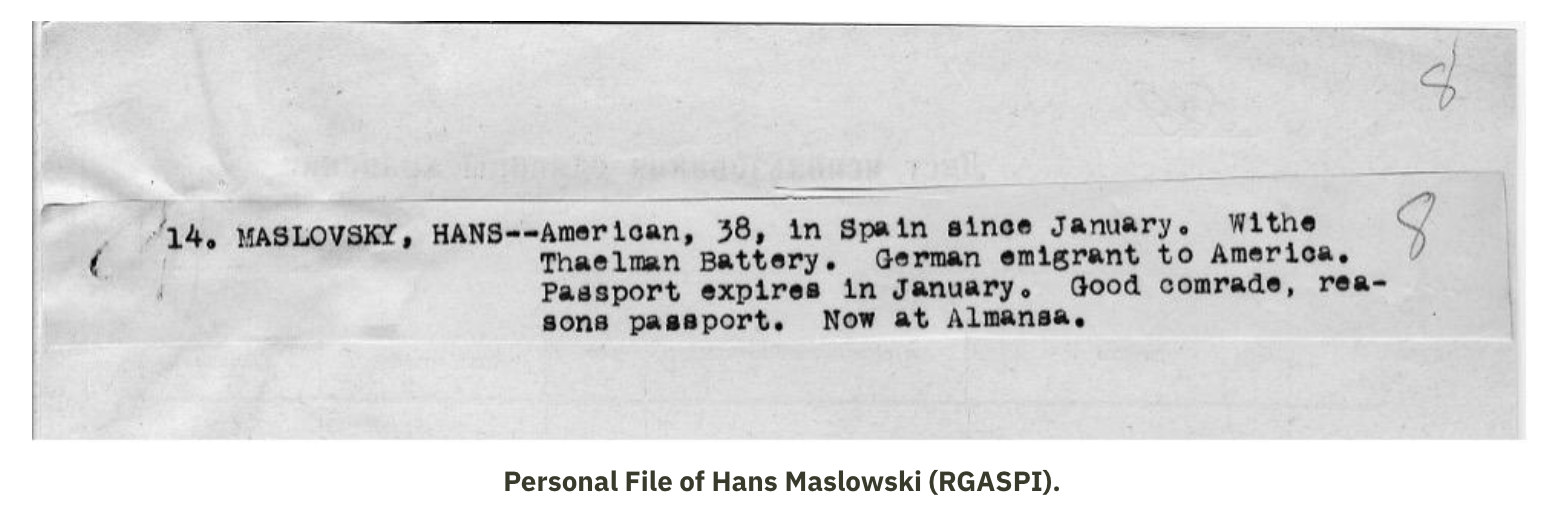
Not all American volunteers joined the Abraham Lincoln Battalion. Due to their citizenship status or language affiliations, some were assigned to other International Brigades units, such as the Italian Garibaldi Battalion or the German Thälmann Battalion. Hans Maslowski, for example, was assigned to the Thaelmann Battery upon arrival in Spain in 1937, even though he had migrated to the United States in 1927 at age 28.
Further Information:
Situation in the United States
Great Depression
At the start of the Spanish Civil War, the United States was in the middle of an intense economic recession known as the Great Depression caused largely by the stock market crash of 1929 and regional banking panics of 1930 and 1931. Unemployment rates and the prices of goods soared during this period. As an increased percentage of the population descended into poverty, public morale and faith in the federal government declined. Despite the relative economic recovery brought about by President Franklin D. Roosevelt’s New Deal policies, Americans increasingly believed that politicians should focus on rebuilding the economy and solving domestic issues before getting involved in conflicts abroad.
Sources:
Library of Congress. “Great Depression and World War II, 1929-1945.”
Neutrality Acts
This sentiment, known as isolationism, was also influenced by growing criticism of U.S. involvement in World War I. Critics viewed the war as an effort by banks and wealthy elites to protect their business affairs in Europe while neglecting the interests of the American people. The rise of fascism in Europe further reinforced Americans’ reluctance to associate themselves with international conflicts. Distrust in the government and economic hardships at home motivated, starting in 1935, the passage of a series of laws titled the “Neutrality Acts,” which barred all involvement in foreign conflicts, including the supply of arms, ammunition, and other military aid.
In direct response to the Spanish crisis, President Franklin D. Roosevelt passed the Neutrality Act of 1937 that, among other things, forbade Americans to travel to Spain.
As a result of the Great Depression, American workers increasingly questioned the ideals of capitalism and democracy and explored other political ideologies. Parts of the working class hoped that communism might resolve the economic and social hardships plaguing the nation.
Sources:
Office of the Historian. “The Neutrality Acts, 1930s.”
PBS Learning Media. “Communism’s Appeal Grows during the Great Depression.”
Black Americans
Some Black Americans were also drawn to communist groups because the latter embraced ideals of equality and rejected racial segregation. This policy was particularly enforced against Black Americans since the 1870s in the aftermath of the American Civil War and Reconstruction. In the American south, white elites created a racial code of conduct called the Jim Crow laws that enforced the racist idea that black people were inferior to whites. Jim Crow laws detailed what black people could or could not do in a white-dominated society. These policies of racial segregation lasted until the mid-1960s. Communist organizations denounced segregation and Jim Crow laws, and they welcomed Black Americans as their equals which attracted some to fight fascism with the International Brigades in Spain. Many Black Americans were also motivated to stop the spread of fascism after witnessing Benito Mussolini’s fascist occupation of Ethiopia in 1935. Not only were the military formations in Spain the first integrated units in American history, but Black American volunteers also became officers in charge of white men.
Sources:
Ferris State University. Jim Crow Museum. “What was Jim Crow”
McCarthyism
While some Americans embraced communist ideology, others held on to isolationism and grew wary of the Soviet Union’s potential influence on communist groups in the United States. Anti-communist rhetoric grew to discredit the efforts of labor unions and civil rights activists. In 1937, anti-communist representatives in Congress formed the House Un-American Activities Committee (HUAC) to monitor American individuals associated with communist organizations. Despite being allies in World War II, the growing fear of communism and concerns about Joseph Stalin’s tyrannical policies turned the United States against the Soviet Union. The two nations entered into a Cold War that lasted from 1947 to 1991. In the 1950s, American anti-communism rose to an all-time high and the Federal Bureau of Investigation (FBI) monitored individuals whom they believed to be associated with communist groups or the Soviet Union. Senator Joseph McCarthy of Wisconsin was a leading figure in public trials against those accused of being communists. Later, historians referred to this period as “McCarthyism.” McCarthy’s investigations were not limited to political leaders but targeted also actors, artists, and hundreds of everyday citizens.
Sources:
UVA. Miller Center. “McCarthyism and the Red Scare.”
The Rosenberg Case
One of the most notorious trials was against Julius and Ethel Rosenberg. Julius was an American electrical engineer who committed espionage for the Soviet Union. Rosenberg and his associates, including his wife Ethel, fed information about American atomic weapons to Soviet officials. In 1951, the Rosenbergs were found guilty and received the death penalty. Various groups in the United States immediately organized to reopen the Rosenberg investigation. They formed the 1951 National Committee to Secure Justice in the Rosenberg Case (NCSJRC).The organization sought to prove the Rosenbergs’ innocence and to pressure the United States government to recognize a miscarriage of justice. The NCSJRC is still insisting on the innocence of Julius and Ethel Rosenberg and seeking justice for them.
Sources:
FBI. Atom Spy Case/Rosenbergs.
NYU. Guide to the National Committee to Reopen the Rosenberg Case Records.
American Labor Movements
AMERICAN LABOR MOVEMENTS IN THE 1930s
Labor Unions started forming in the United States in the 1860s due to poor working conditions created by the Industrial Revolution. Strikes were common throughout the late nineteenth and early twentieth centuries. Many of the labor organizations listed below participated in important strikes that resulted in landmark changes. In the 1930s, labor conditions were extremely exploitative. There were long hours, no minimum wage, and no health and safety regulations. American volunteers who joined the fight in Spain against Franco’s military uprising often came from Unions and the labor movements that fought for social progress and rights.
Sources:
Library of Congress. “Labor Unions during the Great Depression and New Deal.”
American Labor Party (ALP)
The American Labor Party (ALP) was a left-wing political party founded in 1936 by former leaders of the Socialist Party of America and supporters of President Franklin D. Roosevelt. The party operated exclusively in New York and was active from 1936 to 1956. The ALP’s main goal, in their own words, was “sufficient planned utilization of the natural economy so that coal, oil, timber, water, and other natural resources that belong to the American people… shall be protected from predatory interests.” The ALP counted among its members Michael Sidorovich, one of the signatories of the fan. The ALP dissolved in 1955 due to low membership.
Sources:
John Simkin. “American Labor Party.” Spartacus-Educational.
VCU Libraries. Social Welfare History Project. “American Labor Party: 1936.”
International Seamen’s Union (ISU)
The International Seamen’s Union(ISU) was a maritime trade union founded in 1892. It had a profound impact on the shipping industry in the United States and helped pass the Seamen’s Act of 1915, which dramatically changed the lives of American sailors. The Union also participated in the West Coast longshoreman’s strike of 1934, the San Francisco strike, the Auto-Lite Strike, and the Minneapolis Teamsters strike of 1934. Following internal strife, the ISU split into the National Maritime Union and the Seafarer’s International Union. The ISU recruited many volunteers who used their experience as sailors in the Spanish Civil War. Frank Madigan, one of the signatories of the fan, was probably a member of the ISU before he joined the Sailors’ Union of the Pacific (SUP).
Sources:
Seafarers International Union, “SIU & Maritime History.”
Waterfront Workers History Project. “Maritime Workers and Their Unions”
American Federation of Labor (AFL)
The American Federation of Labor (AFL) was an alliance of craft unions in the United States from 1886 to 1955. It was the largest American union before merging with the Committee for Industrial Organization (CIO) in 1955. Members of the AFL went to Spain to fight Franco’s Nationalists. Among the signatories of the fan, at least two belonged to unions affiliated with the AFL: Bob Steffens (Warehouse Workers in San Mateo, California) and John Palu (Building Service Union in Brooklyn, NY.)
Sources:
Ohio History Central. “American Federation of Labor.”
Sailors’ Union of the Pacific (SUP)
The Sailors Union of the Pacific (SUP) was an American labor union founded in 1885. It was highly successful in getting sailors more rights through strikes and legal victories. For example, the SUP was part of the movement that passed the Seamen’s Act of 1915, considered the “Magna Carta” for sailors. The SUP participated in the 1934 West Coast Maritime strike, which granted more rights to longshoremen. Many SUP members fought in the Spanish Civil War. Frank Madigan, John Stuivenberg, and Maurice Hawkins, three of the men who signed the fan, belonged to the SUP.
Sources:
Sailors’ Union of the Pacific. “History.”
Waterfront Workers History Project. “Sailors Union of the Pacific.”
Maritime Federation of the Pacific
Maritime Federation of the Pacific was founded in 1935 between waterfront workers, seamen, and cannery workers. It had a visible presence in California, Oregon, Washington, and Alaska. The organization folded in 1942 due to ideological differences within the organization. Harold Dean, one of the signatories of the fan, was a member of the Maritime Federation of the Pacific.
Sources:
ArchiveGrid : Maritime Federation of the Pacific Coast records, 1935-1942.
ILWU. Local30. “Voice of the Federation.”
Waterfront Workers History Project. “Maritime Workers and Their Unions”
Committee for Industrial Organization (CIO)
The Committee for Industrial Organization (CIO) was founded when it split from the American Federation of Labor in 1935. It participated in the 1936 Rubber Strike and the 1937 Steel Strike. The CIO eventually merged again with the American Federation of Labor in 1955. CIO members also joined the International Brigades in Spain. Michael Sidorovich, a signatory of the fan, belonged to a union affiliated with the CIO: the Federation of Architects, Engineers, Chemists, and Technicians, in New York.
Sources:
Mapping American Social Movements Project. “CIO Unions History and Geography.”
Ohio History Central. “Committee for Industrial Organization.”
United Electrical, Radio and Machine Workers of America (UE)
The United Electrical, Radio and Machine Workers of America(UE) was founded in March 1936 by the Committee for Industrial Organization as a result of the merging of smaller unions. It was officially chartered in 1938. The UE won victories with a successful strike against the Radio Corporation of America and the successful organizing of union members in General Electric and General Motors. Harry Moshier, a signer of the fan, was a member of the UE.
Sources:
UE GALLERY: “UE History. CIO Charter.”
Wisconsin Labor History. “United Electrical, Radio, and Machine Workers of America.”
Steel Workers Organizing Committee (SWOC)
The Steel Workers Organizing Committee(SWOC) was founded by the Committee for Industrial Organization in 1936. Since 1873, there were numerous attempts at organizing steel workers until the SWOC was successfully formed. It participated in the 1937 walkout known as the “Little Steel Strike” for better working conditions. However, this strike ended in defeat. The SWOC was also present at the “1937 Memorial Day Massacre,” in which ten people were killed and 67 wounded. In 1942, the SWOC was disbanded. Harry Moshier, a signatory of the fan, was a member of the SWOC.
Sources:
United Steel Workers. “Our History.”
Minnesota Farm Labor Party (MFLP)
The Minnesota Farm Labor Party(MFLP) was a socialist-leaning political party that dominated Minnesota politics from 1918 to 1944. It produced three governors, four senators, and eight representatives. It emerged from the populist Farm-Labor movement and eventually merged with the Democratic Party in 1944. Some of its members became international volunteers in Spain. A signatory of the fan, Harry Moshier, was a member of the MFLP.
Sources:
Tom O’Connell. “Minnesota Farmer-Labor Party, 1924-1944.” Mnopedia.
John Simkin. “Farmer-Labor Party.” Spartacus-Educational.
Confederación Nacional del Trabajo (CNT)
Learn more about the Confederación Nacional del Trabajo (CNT), translated as National Confederation of Labor.
Communist Organizations
Soviet Union
During the Spanish Civil War (1936-1939), the Soviet Union supported the Republican side. Already in 1935, in the aftermath of Hitler’s rise to power, the Soviet Union had influenced the Comintern to take up the policy of building Popular Front governments. In Spain, the Partido Comunista de España(PCE), the Spanish Communist Party,joined the Spanish Popular Front, winning the elections in February 1936. Once the civil war broke out in July, the communist influence in Republican Spain grew. The Soviet Union provided weapons and military advisors and, through the Comintern, coordinated humanitarian aid to the Spanish Republic and helped organize the International Brigades. The Soviet Union used its growing influence in Spain to prevent other leftist groups, such as the Confederación Nacional del Trabajo (CNT) or the POUM (Partido Obrero de Unificación Marxista),from pursuing a social revolution, focusing instead on defeating the Spanish Nationalists.
Sources:
International Brigade Memorial Trust (IBMT). “The Soviet Union and the Spanish Civil War.”
Comintern
Abbreviation of the Communist International, also known as the Third International. Established by Vladimir Lenin in 1919, the Comintern was a coalition of national communist parties headed by the Soviet Union. Its original goal was the spread of world communism. By 1935, the rise of fascism led the Comintern to abandon the ideal of social revolution and to embrace instead the defense of liberal democracy through the Popular Front. During the Spanish Civil War, the Comintern played a key role in coordinating the various policies on Spain by national communist parties. It also funneled aid to Spain and organized the International Brigades.
Sources:
Marxist Internet Archive. “The Communist International.”
Communist Party of the United States of America (CPUSA)
The CPUSA was established in 1921 after a split with the Socialist Party of America two years earlier. During the 1930s, its membership grew in part due to Americans’ disillusionment with capitalism in the aftermath of the Great Depression and the rise of fascism. The CPUSA officially aided Republican Spain by raising funds for medical and humanitarian relief. Unofficially, it also helped recruit American volunteers to fight in Spain with the International Brigades. Shortly after the Spanish Nationalists won the civil war, the Soviet Union and the United States found themselves fighting as allies against Nazi Germany in World War II. After World War II, their ideological differences led to the Cold War. In the United States, during the McCarthy era, Americans suspected of supporting communism were persecuted. Many American volunteers who had served in Spain were investigated by Senator Joseph McCarthy or by the FBI because of their party affiliation.
Sources:
Marxist Internet Archive. “Communist Party, USA.”
North American Committee to Aid Spanish Democracy (NACASD)
Established in 1936, this was one of the main organizations that coordinated the raising of funds and humanitarian aid to Republican Spain. While close to the CPUSA, it was an umbrella organization that included a variety of pro-Republic and antifascist associations from ethnic societies to trade unions.
Sources:
Sonia García López. “Loyalist Voices Crying Out across the Ocean.” The Volunteer. 2 May 2020.
Partido Comunista de España (PCE)
The Spanish Communist Party was established in 1921 after a split with the Spanish Socialist Workers’ Party (PSOE). The PCE was one of the parties that made up the Spanish Popular Front. While relatively small before the war, the PCE gained membership and popular support during the Spanish Civil War. This was partially due to the PCE’s emphasis on fighting for a Republican military victory while stalling efforts for a broader workers’ revolution. At the end of the Spanish Cicil War, many leaders of the PCE, like the famous orator Dolores Ibárruri, known as Pasionaria, went into exile to the Soviet Union. The PCE was banned during the Franco dictatorship (1939-1975) but legalized again in 1977 during Spain’s transition to democracy.
Sources:
Marxist Internet Archive. “Dolores Ibárruri ‘La Pasionaria.’”
Confederación Nacional del Trabajo (CNT) and POUM (Partido Obrero de Unificación Marxista)
The CNT, or National Confederation of Labor, was a Spanish confederation of anarcho-syndicalist labor unions, and not a communist organization. They wanted to give full control of the means of production (like factories) directly to the labor unions without an overarching government. During the Spanish Civil War, the CNT and the POUM (the anti-Stalinist Workers’ Party of Marxist Unification) pushed for a workers’ revolution. But other supporters of the Spanish Republic, including the Spanish Communist Party (PCE), prioritized winning the war against Franco’s Nationalists. In May 1937, infighting between these groups broke out in Barcelona, which led to the eventual repression of anarchists in Catalonia in 1937. Supporters of the CNT and POUM were militarily defeated by Republican forces, the latter backed by the PCE and the Soviet Union. Under Franco’s dictatorship the CNT was persecuted and forced to act clandestinely.
Sources:
Andy Durgan. “Revolutionary Anarchism in Spain: the CNT, 1911-1937.”
Marxist Internet Archive. “Workers’ Party of Marxist Unification (POUM).”
Warwick Library. “The Barcelona May Days, 1937.”
Popular Front
A policy established officially by the Comintern in 1935, the Popular Front was part of the Soviet strategy to build friendlier relations with their former political adversaries, like social and liberal democrats. The Popular Front wanted to create unity against the common enemy of fascism, particularly in Nazi Germany and then in Spain. In Spain, the Frente Popular (a coalition that included socialists, communists, and liberal Republicans) won the elections in February 1936. It was against this elected government that General Franco would rebel in July 1936 and start the civil war.
Sources:
Encyclopedia of Marxism. “Popular Front (aka People’s Front).”
Young Communist League (YCL)
The youth wing of the Communist Party of America (CPUSA), whose membership grew in the 1930s. Many volunteers of the International Brigades belonged to the YCL. Two of the men who signed the fan, Michael Feller and Michael Sidorovich, were members of the Young Communist League.
Sources:
Marxist Internet Archive. “Young Communist League.”
Communist Leaders
Stalin/Trotsky divide
Communists began to split along different ideological lines after Vladimir Lenin, the leader of the Soviet Union, died in 1924. Josef Stalin took control of the Soviet Communist Party after he defeated Leon Trotsky, another leader of the Russian Revolution and head of the Red Army. Stalin exiled Trotsky in 1929. In 1938, Trotsky and his followers established the Fourth International as an alternative to the Third International (Comintern) supported by Stalin and the Soviet Union. Trotsky’s Fourth International was committed to the revolution and world communism. In Stalinist Soviet Union, Trotskyists suffered the repression of the Great Purges (1937-1938). In Spain, this conflict pitted the Spanish Republican government, backed by the Soviet Union, against the Trotskyist Workers’ Party of Marxist Unification (POUM). After the infighting in May 1937, the Spanish Republic banned the POUM and arrested many of its leaders. In 1940, Trotsky was assassinated in Mexico City by Ramon Mercader, a Spanish communist agent who had fought in the Spanish Civil War.
Sources:
Leon Trotsky. “Collected Writings on the Spanish Revolution.” Trotsky Internet Archive.
Earl Browder (1891- 1973)
General Secretary and Chairman of the Communist Party of the USA (CPUSA) from 1930 to 1945, and twice Presidential candidate (1936 and 1940). Browder visited Spain during the Spanish Civil War. In 1937, he addressed volunteers from the Abraham Lincoln Brigade after the battle of Teruel.
Sources:
David Jorge and Sebastiaan Faber. “Naming the Lincoln Battalion.” The Volunteer (13 March 2016).
Encyclopedia of Marxism. “Earl R. Browder”
Ernst Thälmann (1886-1944)
German communist and head of the German Communist Party (KPD) from 1925 to 1933. Following Hitler’s rise to power in 1933, Thälmann was arrested by the Gestapo (German Secret Police). He was imprisoned for eleven years and eventually executed in the concentration camp of Buchenwald on Hitler’s personal orders. Several units of German volunteers in the International Brigades, who were themselves political exiles of Nazi Germany, were named after Thälmann, like the well-known Thälmann Battalion. Hans Maslowski, the owner of the fan with the signatures, was originally assigned to the Thälmann Battery.
Sources:
Gedenkstätte Deutscher Widerstand. “Ernst Thälmann.”
Memorials in Hamburg in Remembrance of Nazi Crimes. “Ernst Thälmann memorial.”
Fascism
Scholars debate numerous definitions of fascism and how they resemble or differ from other repressive political systems such as authoritarianism, Nazism, nationalism, or totalitarianism. In general, fascism is a form of government and economic system that severely limits individual freedom and rights and controls the economy. Fascist governments are typically controlled by a single leader. No one is more powerful than such leaders and the rule of law does not apply to them. Fascism is also characterized by an “us” versus “them” mentality.
Hitler’s Germany and Mussolini’s Italy are considered fascist states. Adolf Hitler (the Führer) and his Nazi party came to power in Germany in 1933, pursuing a racial ideology that aspired to create a pure “Aryan” German nation. Benito Mussolini (Il Duce), who founded the National Fascist Party in Italy, came to power in 1922 and was deposed in 1943. Both Hitler and Mussolini supported Franco’s military coup to destroy the democratically elected Spanish Republic. Some historians argue that Franco’s form of governance can also be called fascist. While Hitler and Mussolini did not survive World War II, Franco’s dictatorship lasted until his death in 1975.
Learn more about fascism
Mindy Weisberger. “What is Fascism?” LiveScience. 29 November 2021.
Arrivals & Departures
When international volunteers from around the world decided to join the Spanish Civil War, an important question was always how to cross borders and reach Spain. For American volunteers, it first meant to find a ship to cross the Atlantic to Europe. The United States signed the Neutrality Act in August 1935 (amended in May 1937) that made it illegal to travel to Spain, seeking to prevent American volunteers from joining the International Brigades. It also prohibited the sale and transport of arms as well as financial assistance to Spain. Additionally, in August 1936, the United States signed the Non-Intervention Agreement with several other countries, including France and the United Kingdom. After the devastation of World War I, they hoped to prevent another global war by limiting foreign involvement in armed conflicts.
To circumvent the authorities, American volunteers traveled to Europe, pretending to be students, tourists, or archeologists. Many American volunteers made their way on ships to the north of France, then continued to southern France eventually crossing into Spain. In the beginning, volunteers crossed by boat, but then they became targets of Franco’s Nationalist forces and their Italian allies. In May 1937, for example, the Ciudad de Barcelona with over 200 volunteers on board was torpedoed by the Nationalists off the Catalonian coast, killing scores of people, among them over a dozen American volunteers. The other route to Spain was walking across the treacherous Pyrenees mountains. About 200 volunteers died attempting to cross these mountains before they could set foot on Spanish soil.
After Franco’s victory in Spain in April 1939, returning home was difficult for the International Brigades volunteers. Many faced challenges regarding their legal citizenship status by their home countries since they had been fighting illegally in Spain. While some volunteers were repatriated quickly, others spent months in French internment camps or remained exiled in other European countries. The beginning of the Second Word War in September 1939 complicated their situation further. Some were eventually sent to Nazi German concentration camps.
Sources:
Chris Brooks. “85th Anniversary—Sinking of the Ciudad de Barcelona.” The Volunteer (28 May 2022).
Giles Tremlett. “The Afterlives of the International Brigades.” HistoryToday (15 October 2020).
Alan Warren and Sonia Garangou. “The Sinking of the ‘Ciudad de Barcelona,’ 30th May 1937.”
The Voyages to Spain
The American volunteers who signed our fan arrived in Spain over a period of several months in the course of 1937. John Palu and Hans Maslowski sailed together from New York on the SS Paris on February 6, 1937. Carl Slater and Ramon Pedrero left later that month on the President Roosevelt and the Ille de France respectively Bob Steffens and Michael Feller boarded the Queen Mary to France on October 20, 1937. Three other volunteers (Michael Sidorovich, Walter [Ted] Lewis, and Joseph Yonules) followed a few days later. The rest departed in the spring and summer: Bali Kilas in March, Peter Reed in May, John Stuivenberg and Harold Dean in June, Maurice Hawkins in July, Harry Moshier in August, and Marshall Yermendjian in September.
The transatlantic crossing usually lasted about a week. But as the war conditions in Spain changed, so did the travel experiences of the volunteers. Arriving in France in February 1937, John Palu, for example, entered Spain by bus from Perpignan, a town on the French Mediterranean coast. When France closed the border with Spain in March 1937, volunteers were forced to travel by land further west to cross the Pyrenees on foot. Arriving at the Catalan villages of Massanet and Setecases, they were taken to the town of Figueres and joined the International Brigades in Albacete and other locations.
Sources:
Chris Brooks. “A Disturbing Trend in Recruitment.” The Volunteer. (10 January 2020).
Repatriation
After the Spanish Prime Minister, Juan Negrín, proclaimed in September 1938 that all international volunteers were to return to their home countries, most volunteers were evacuated from Spain. The return of American volunteers was complicated by the fact that many no longer had passports; others needed special permission to return because they had entered Spain illegally. The League of Nations set up a Repatriation commission to assist the volunteers with their repatriation.
The men who signed the fan received the news of the repatriation while fighting in Levante. They were initially taken to the countryside around Valencia. It was in Villanueva de Castellón that they met the Repatriation Commission in December 1938. In January 1939, they were taken by truck to the port of Valencia where they sailed to Barcelona. They continued north by train, joining other volunteers at Cassà de la Selva and Figueres on their way to the French border. Retracing the steps taken at the start of their trip, they moved from southern France to Paris and eventually to Le Havre to board a ship to New York. Most of them sailed on the President Harding on January 26, 1939, arriving in New York on February 4, 1939. Significantly, four of the European-born volunteers (Hans Maslowski, John Palu, Ramón Pedrero, and John Stuivenberg) had a different journey. All of them were detained in French camps.
Sources:
Camps
While waiting for repatriation, some international volunteers were detained in French camps when crossing into France. These camps were built to contain the influx of refugees fleeing from Spain after Franco’s victory. The majority of the refugees were Spaniards but some were International Brigades volunteers. Sidney Kaufman, John Palu, and Ramon Pedrero Perez were sent with other Republican soldiers and Spanish men to a French camp at Argelès-sur-Mer, with no shelter and few supplies, while Hans Maslowksi and John Stuivenberg were detained in the camp of St. Cyprien. Maslowski was not able to return to the United States until March 24, 1939. Stuivenberg, whose departure was delayed until April 1939, was deported after his arrival to the United States and had to return to the Netherlands. Palu returned to New York in April 1940, on a ship sailing from Tangiers, Morocco. We do not know whether Pedrero, a Spaniard, was able to return to the United States.
In many cases, international volunteers had to obtain special permissions from their national governments to return. The United States worked relatively quickly to bring their volunteers home. When Americans were imprisoned in French camps, they usually stayed only for a short time. Volunteers from other nationalities, especially when their governments did not support the Spanish Republican cause, were not as lucky. Among them were Germans and Austrians. Austrian International Brigades volunteer Hans Landauer, for example, was arrested in Nazi occupied Paris and sent to the Dachau concentration camp near Munich in June 1941. Spanish Republicans who ended up in French camps were also transferred to Nazi concentration camps. In the Mauthausen concentration camp, for example, survival chances were determined by the national identity of prisoners. Spanish Republicans initially had a very low survival rate, often murdered soon after their arrival. After an influx of other prisoner groups, however, the Nazis considered them less dangerous, and their survival chances increased. It is estimated that around 10,000 Spaniards were deported to concentration camps; close to half of them died at the camp of Mauthausen alone.
Sources:
European Observatory on Memories (EUROM). “Argèles-sur-Mer.”
Mauthausen Memorial. The Mauthausen Concentration Camp, 1938-1945. “Groups of Prisoners.”
The National WWII Museum. “A Shocking Level of Brutality and Degradation: Dachau in Wartime.”
Battles
Battles of the Spanish Civil War
The Spanish Civil War (1936-1939) was fought on many fronts. International volunteers participated in some of them. The men who signed the fan belonged to the 15th International Brigade, which was particularly active near Madrid and in the Aragon front. The brigade first fought at the battle of Jarama in February 1937 and continued until the final battles around the Ebro. The International Brigades were dissolved in September 1938. It is estimated that 15% of the International Brigade volunteers died, with a 40% casualty rate.
Jarama (February 1937)
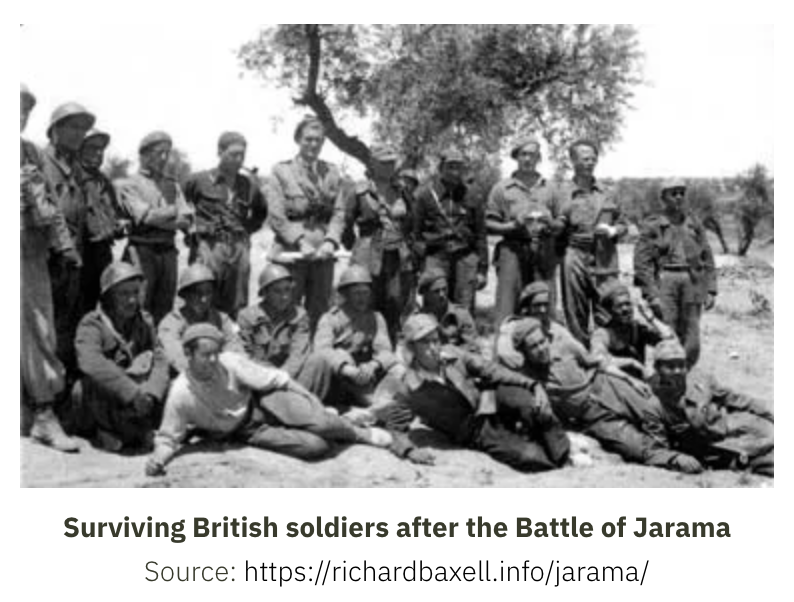
The battle of Jarama was the first battle the 15th International Brigade fought in Spain. It took place in the valley of the Jarama river (east of Madrid) in February 1937. In November 1936, fearing the fall of Madrid, the capital of Republican Spain had been moved to Valencia in the Mediterranean coast. The role of the International Brigades was to defend the Madrid-Valencia road and prevent the capture of Madrid by the Nationalists. The International Brigades suffered heavy losses, but they achieved their goal. Madrid remained in Republican hands until the end of the war in 1939.
Sources:
Spanish Civil War. Virtual Museum. “The Battle of the Jarama.”
Belchite (August-September 1937)
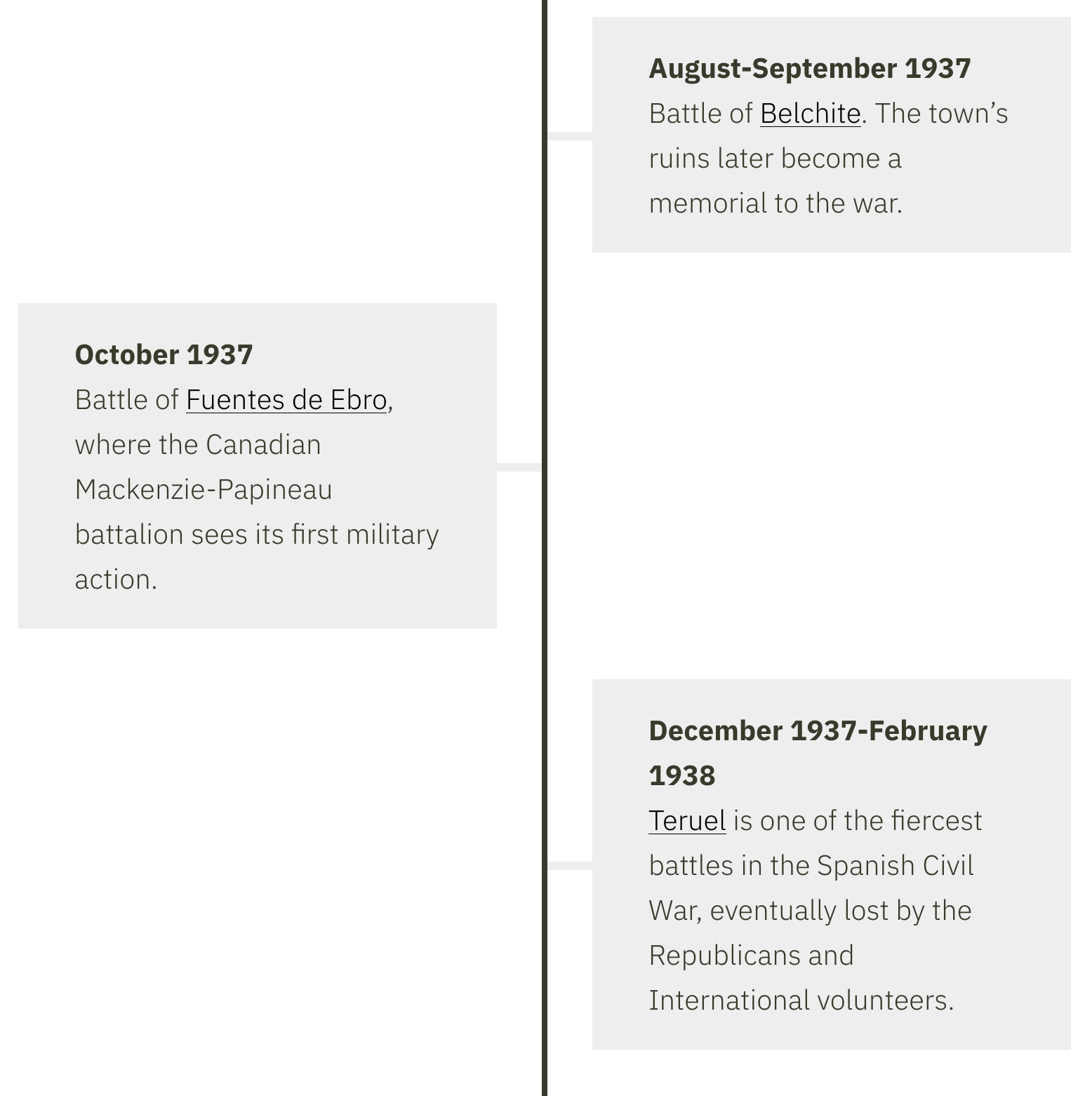
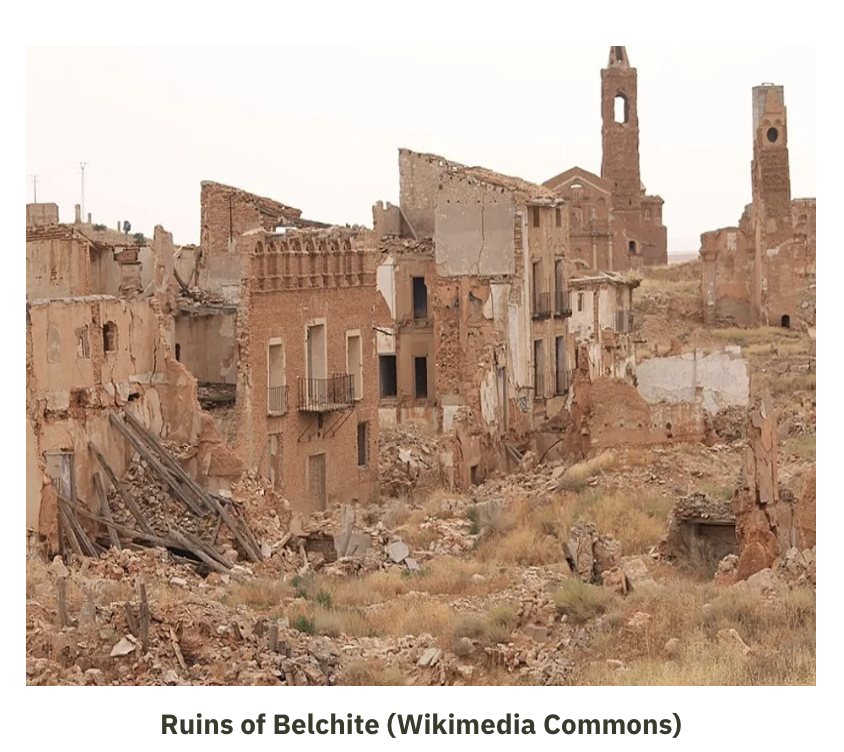
A small town near Zaragoza. The battle of Belchite was one of several battles that took place in the Aragon front in the summer of 1937. Starting on August 24, 1937 Republican troops, including the 11th and 15th International Brigades, launched an offensive against the Nationalists. After fierce house-to-house combat, Belchite surrendered on September 6, 1937. Belchite would be recaptured by the Nationalists in March 1938. After the Civil War, Franco preserved the ruins of the town as a living monument to the war.
Sources:
Brunete (July 1937)
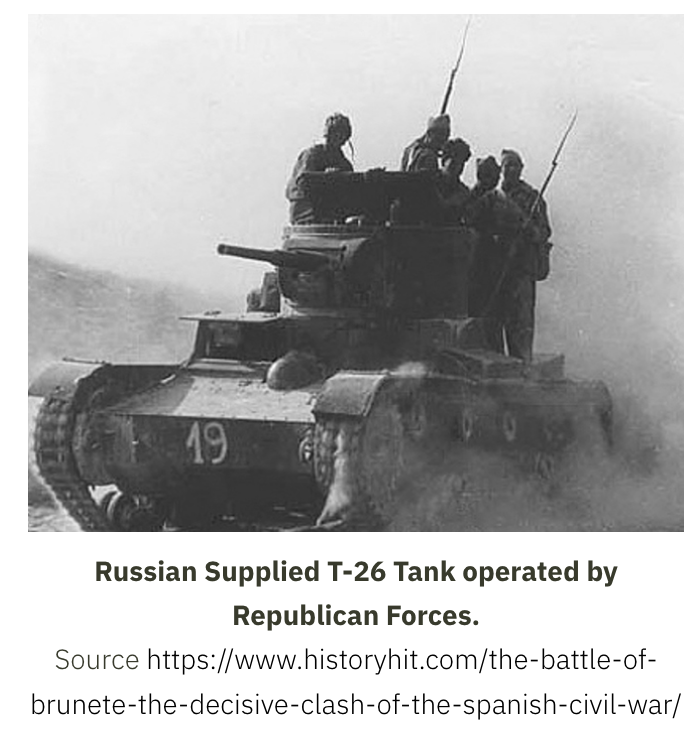
A small town in the outskirts west of Madrid. The battle of Brunete took place during July of 1937. An initially successful Republican attack in early July was eventually repelled by the Nationalists who recaptured Brunete at the end of July. The 15th Brigade suffered heavy losses. The Americans lost over 300 men, forcing them to combine their two battalions (the Abraham Lincoln and the George Washington) into one: the Lincoln-Washington. Because of the high death rate among International Brigades volunteers, grumbling, insubordination, and desertion became more frequent.
Sources:
Spanish Civil War. Virtual Museum. “Destruction at Brunete.”
Fuentes de Ebro (October 1937)
A small town southeast of Zaragoza, on the Ebro river. Like Belchite, the battle of Fuentes de Ebro was part of the Republican offensive in the Aragon front aiming to capture Zaragoza. The 15th Brigade was sent to Fuentes de Ebro in October 1937. This would be the first military action of the recently created Canadian battalion (Mackenzie-Papineau). Despite heavy losses, Republican forces were not able to take Fuentes del Ebro and to open the path to the conquest of Zaragoza, which remained in Nationalist hands.
Sources
Spanish Civil War. Virtual Museum. “Mackenzie-Papineau Battalion Monument, Toronto.”
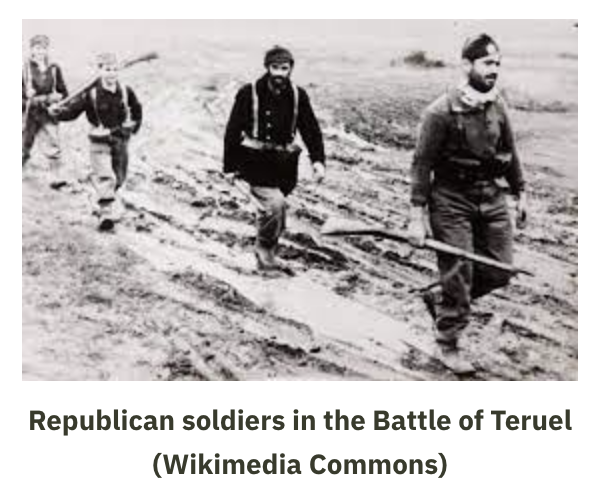
Teruel (December 1937-February 1938)
The battle for the city of Teruel (in southern Aragon) was one of the bloodiest in the war. It lasted two months (December 15, 1937 to February 22, 1938). The Republican offensive was initially successful, and the Nationalists surrendered Teruel on January 8. But within a couple of weeks, the Nationalist counteroffensive began in earnest, and by February 22 they had recaptured the city. Following the victory at Teruel, the Nationalists began the Aragon offensive as the exhausted Republican troops retreated.
Sources
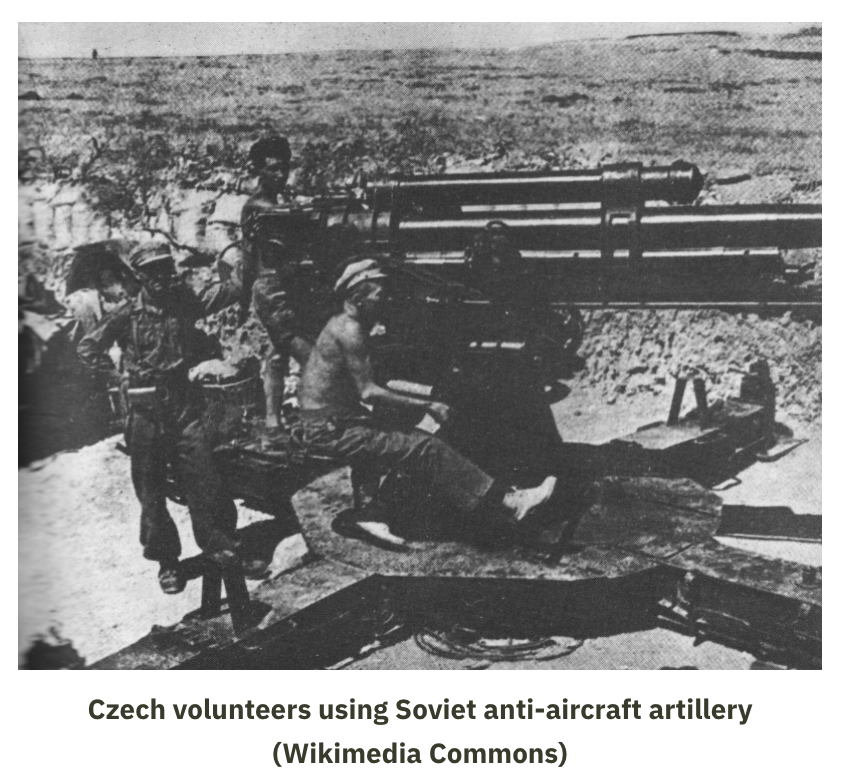
Aragon Offensive and the Great Retreats (March-April 1938)
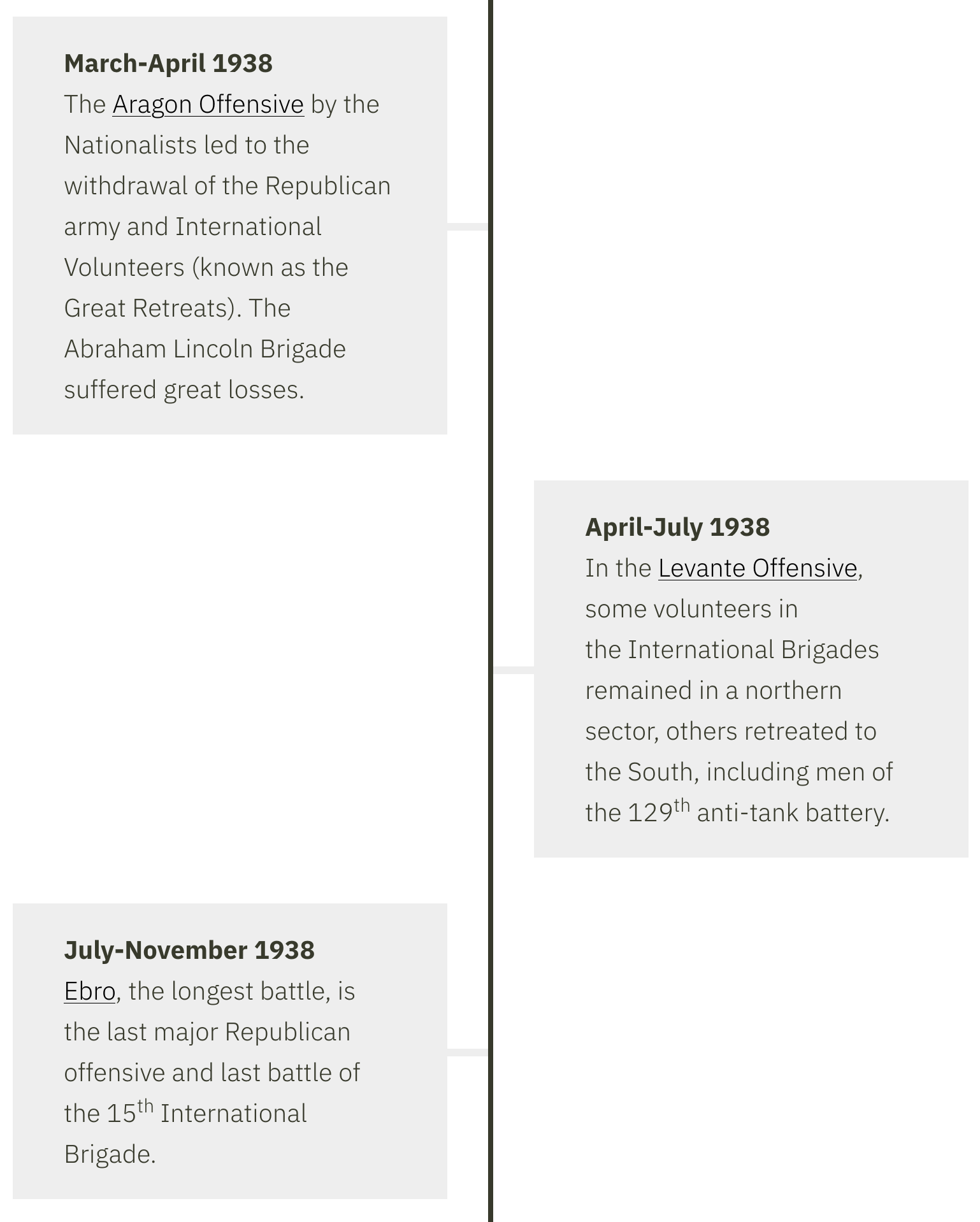
The Aragon Offensive, led by the Nationalists, started on March 7 and ended on April 19, 1938. Following the victory at Teruel, the Nationalists pushed through the Republican front lines as Republican forces chaotically withdrew in what became known as the Great Retreats. In March, the Nationalists retook several towns, including Belchite, and by mid-April they had reached the Mediterranean, cutting the Republican territory in two and separating Catalonia from the rest of Republican Spain. The Nationalists were stopped at the Ebro river when the retreating Republicans blew up the bridges. During the retreats, the Abraham Lincoln Brigade suffered great losses, including its commander, Robert Merriman.
Sources
Spanish Civil War. Virtual Museum. “Francoist Soldiers Reach the Mediterranean.”
Levante Offensive (April-July 1938)
Having defeated the Republican forces in the Aragon front, the Nationalists turned south and attempted to capture Valencia from April to July 1938. While most of the International Brigades remained in the northern sector, a number had ended up in the South during the retreats. Among them were the men of the 129th anti-tank battery. They now fought under the army of the Levant. In the meantime, the Republican forces in the north planned a new offensive, crossing the Ebro river to regain the territory just captured by the Nationalists and to stop the Nationalists advance on Valencia.
Sources
Ebro (July-November 1938)
The longest battle of the war, the battle of the Ebro started on July 25 and ended on November 16, 1938. The Republican forces crossed the river at several points. Their advance took the Nationalists by surprise. During the following months, however, the Nationalists recovered the territory they had lost at the start of the battle. This was the last major Republican offensive and the last battle of the 15th International Brigade. On September 21, the Spanish Prime Minister, Juan Negrín, announced the withdrawal of the International Brigades, hoping, in vain, that Franco would also renounce the military support he received from Mussolini’s Italy and Hitler’s Germany. The International Brigades received the gratitude of Republican Spain in a series of farewell parades as they prepared to leave the country. It is estimated that a third of the American volunteers died in Spain.
Sources
Medical Care
To take care of the wounded among the international volunteers was a serious challenge. During the war, the Brigades managed over twenty hospitals and 1,500 medical personnel across Republican Spain. Understaffed and without adequate supplies, medical care was often improvised, and the medical personnel worked under atrocious conditions. The makeshift hospitals in Republican Spain lacked suitable space, medication, doctors, nurses, and other essential materials. Medical stations and ambulances on the front lines were often targeted by Franco’s Nationalist forces.
Americans supporting the Republican cause in Spain raised money for humanitarian aid for the international volunteers as well as the Spanish population in general. Other Americans with medical expertise traveled to Spain to assist as nurses, doctors, and ambulance drivers, including those who volunteered in the Abraham Lincoln Brigade. Sidney Vogel, a New York surgeon who served as director of several hospitals in Spain, described the challenging conditions of medical care on the front lines in an unpublished paper, War Medicine: Spain, 1936-39.
Nurses, Doctors, and Ambulance Drivers
Many American nurses, doctors, and ambulance drivers volunteered their services by traveling to Spain to support the Spanish Republic. Some went to Spain as non-combatants with the International Red Cross Committee or through the American Medical Bureau to Aid Spanish Democracy. Others directly joined the Lincoln Brigade as medical personnel.
The medical situation in Spain during the war was dire. Before the war, medical care was often provided by religious orders, especially Spanish nuns. The anti-clericalism of the Popular Front government caused a rift between the Catholic Church and the left-wing government. When the Spanish Civil War started, violence against churches, priests, and nuns further divided the government and the Catholic Church. Since the church hierarchy sided with the rebels, many nuns left for Nationalist Spain. As a result, there was a shortage of nurses on the Republican side. International women volunteers, including Americans, stepped in to fill the vacuum. Of particular note is Salaria Kea, the only African-American woman to serve in Spain. She had advocated for the Spanish Republic while still working as a nurse in the United States before she herself left to Spain to provide medical care for the international volunteers.
The American volunteer nurses and doctors had to work in makeshift hospitals, helping the injured. Like some of the men who had signed the fan, they were sent to Benicàssim to recover. Located on the Mediterranean coast, 50 miles north of Valencia, Benicàssim had been a resort for wealthy Spaniards. The International Brigades turned it into a hospital and convalescence center for thousands of injured volunteers. The medical conditions at Benicàssim were poor but far better than on the battlefronts. On the frontlines, ambulance drivers were targeted by enemy airplanes and they had to navigate the constantly changing maps to avoid driving accidentally behind enemy lines. Those who traveled to Spain to offer medical aid risked—and often lost—their lives.
Sources
The Abraham Lincoln Brigade Archives (ALBA). “Salaria Kea: A Negro Nurse in Republican Spain.”
Kathryn Everly. Salaria Kea in the Archive. The Volunteer. 11 February 2022.
Medical Aid for Spain. The Work of the Spanish Medical Aid Committee.
The International Red Aid, also known as Socorro Rojo Internacional, was a communist organization founded by the Comintern in 1922. It was created as a political alternative to the International Red Cross to provide aid to the victims of class warfare. During the Spanish Civil War, it was led by the Spaniard Joaquín Arderíus. The International Red Aid provided soup kitchens, organized refugee camps, set up makeshift hospitals, transported injured troops, and aided children. By the end of the Spanish Civil War, Arderíus fled Spain. In 1943, the organization was dissolved.
Sources
Call for information on Spanish Civil War time Socorro Rojo
The North American Committee to Aid Spanish Democracy was an umbrella organization created in 1936 dedicated to raising funds for the Spanish Republic. As a coalition of labor unions, ethnic groups, and a wide spectrum of leftist organizations, it was tied to the Communist Party of the United States (CPUSA). Because the American Neutrality Acts of 1936 and 1937 made it illegal for citizens to provide any aid to Spain during the Spanish Civil War, the United States refused to take sides. With one exception: Medical assistance was permissible. The North American Committee to Aid Spanish Democracy used this opportunity to raise funds for the embattled Republic and to support campaigns such as the lifting of the arms embargo against Republican Spain.
Sources
Lift the embargo against Spain : a survey of the facts, a call to action.
Image Politics: U.S. Aid to the Spanish Republic and Its Refugees.
The American Medical Bureau (AMB) was an American organization founded by Dr. Edward K. Barsky in 1936, intended to raise funds to provide humanitarian aid to the Spanish Republic and to shift public opinion against the ongoing boycott of aid to Spain. The AMB also recruited medical professionals in America for the Spanish Republic, many of them women who held leadership positions. In 1938, it merged with the North American Committee to Aid Spanish Democracy.
Sources
Marx Memorial Library. International Solidarity Fund. “Aid for Spain.”
Spanish Civil War. Virtual Museum. “Milk for Spain.”
XV International Brigade in Spain. “Medical Services.”
Edward Barsky was an American surgeon and leftist political activist. He grew up in New York City and became a surgeon at Beth Israel Hospital. In 1937, he traveled to Spain with a group of medical practitioners to aid the Abraham Lincoln Brigade soldiers. In Spain, he was promoted to Surgeon General of International Sanitary Services, overseeing hundreds of international medical volunteers. After the Spanish Civil War, Barsky helped found the Joint Anti-Fascist Refugee Committee, which focused on providing aid to Spanish refugees and political prisoners. As chairman of this organization, Barsky was called before the House Un-American Activities Committee, but he refused to hand over the books and financial paperwork of the Joint Anti-Fascist Refugee Committee. He was convicted of contempt of Congress. After many appeals, Barsky was sentenced to five months in prison and suspension of his medical license for six months. He eventually returned to work at Beth Israel Hospital and remained a political activist. He passed away in 1975 at age 78.
Sources
“Edward Barsky, Surgeon, Dies; Joined Spanish Republican Side.” New York Times, 13 February 1975.
American Women and the Spanish Civil War
The fan was signed by 31 men who volunteered in the International Brigades in the Spanish Civil War. No women signed it, though many women had also joined the fight against Franco’s Nationalists. Some American women volunteered in Spain to take care of the wounded in makeshift hospitals while others, like journalist Martha Gellhorn, contributed by reporting from Spain. Women in the Communist Party USA (CPUSA) were not only motivated to fight against fascism but also looked for organizations that supported gender equality, body autonomy, and children’s safety at home and abroad. For them, the Spanish Nationalist insurrection was not just a class war but also a war against women’s rights.
Under the democratically elected Spanish Republic, progress had been made concerning women’s rights, including their right to vote. Following Franco’s military uprising, Republican women joined the fight against Franco’s forces. Some of these milicianas (mostly anarchists and communists) fought on the front lines and became an iconic image of the war in its early months. In Nationalist Spain, however, women’s rights were revoked. Civil divorces were suspended, access to education restricted, and safe abortions outlawed. Schools were segregated again by gender, which severely impacted the education of young girls.
One of the primary roles of American women in the Spanish Civil War was to volunteer as nurses. Among them was Salaria Kea, a Black American woman who attended nursing school in Harlem. She became an activist for the Republican cause in the United States before joining the International Brigades in Spain as a nurse. Another American nurse and member of the CPUSA, Lini Fuhr, described her experience in Spain as “something overwhelmingly worthwhile.” Fuhr served at the battle of Jarama, where the makeshift hospital was quickly overcome with the number of injured soldiers. Another American woman, Evelyn Hutchins, became the only female ambulance driver in the International Brigades. Hutchins complained about “male chauvinism” among her fellow male volunteers, who argued that driving trucks was a “man’s job.” Ambulance drivers were carefully selected: not only did they drive trucks but also had to be able to perform mechanical work.
Other American women worked as journalists in Spain, some of whom were members of the CPUSA. From 1937 to 1938, Martha Gellhorn told stories of wartime through the eyes of the civilians she encountered. She worked alongside Ernest Hemmingway, who later became her husband. Milly Bennett (Mildred Bremler) was another American journalist who, despite the fact that her application to become a member of the CPUSA was rejected, traveled to Spain in December of 1937 from the Soviet Union, where she had lived since 1931. During her time in Spain, Bennett worked for the press and propaganda services in the English language department of the Spanish Government. After her time in Spain, Bennett was accused by the FBI of spying for the Spanish Republic.
Women also played important roles at the home front, supporting male volunteers as mothers, sisters, companions, and wives. At times, mothers were deeply worried about their sons fighting in Spain. For example, one of the signatories of the fan, Michael Feller, joined the International Brigades with his nephew Hyman Katz. Their correspondence includes letters to mothers and sisters explaining the importance of fighting fascism, despite the dangers. As wives, women also supported their husbands. Anne Hanusiak, for example, married Michael Sidorovich, a signatory of the fan, in 1941. While she did not know him during the war, she played a pivotal role in his later political life. According to the records of the Rosenberg trial, the FBI suspected Anne and her husband of espionage for the Soviet Union. Another example is Agnes Cecelia Jessen, the wife of another signatory of the fan, Carl Slater. As an artist, Agnes was also politically active and worked in the WPA (Work Progress Administration) during the 1930s. Later, during the Vietnam War, she was involved in the antiwar movement and the Women’s International League for Peace and Freedom.
Sources
Kea, Salaria. Spanish Civil War. Virtual Museum. “An African American Nurse in Republican Spain.”
Rahman, Evelyn Hutchins, Jim Firth et al. “Evelyn Hutchins. Male Arrogance Defeated.” In Women’s Voices from the Spanish Civil War. Lawrence& Wishart. 2008. 155-156.
Fuhr, Lini Moerkirk. NYU Libraries. “Guide to the Lini M. De Vries Papers.”
Sam Knight. “A Memorial for the Remarkable Martha Gellhorn.” New Yorker. 18 September 2019.
Bennett, Milly et al. Spanish Women Doing Great Work
Abraham Lincoln Brigades Archives (ALBA). “Women and the Spanish Civil War (Workshop).
Jim Firth et al. Women’s Voices from the Spanish Civil War. Lawrence& Wishart. 2008.
Julia Newman (Director). 2003. “Into the Fire: American Women in the Spanish Civil War.”
Other 20th Century Wars
World War I started on July 28, 1914 after the assassination of Archduke Franz Ferdinand of Austria. It ended on November 11, 1918 with an armistice with Germany. The Allies (France, Russia, Great Britain, and later the United States) fought the Central Powers, which consisted of the German Empire, Austria-Hungary, and the Ottoman Empire in a series of battles involving trench warfare and new military technology of tanks and airplanes. World War I reshaped Europe’s political geography and contributed to the Russian Revolution that turned Czarist Russia into communist Soviet Union.
The Interwar Period refers to the years between the two world wars (1918-1939). This period saw the rise of fascism in Europe and the establishment of two fascist regimes, in Italy and Germany. The Spanish Civil War (1936-1939) was a fight against Fascism. Spanish Republicans defended the democratically elected government against Spanish Nationalists who supported the military uprising led by General Franco. Franco received aid from Hitler and Mussolini. The appeasement policy of Western democracies contributed to the spread of dictatorial regimes, especially regarding Nazi Germany’s domestic repression and eventual invasion of Poland, which marked the beginning of World War II.
World War II started when Nazi Germany invaded Poland on September 1, 1939. The Axis powers, which consisted of Germany, Italy, and Japan, eventually fought against the Allied forces of the Soviet Union, the United States, Great Britain, and France. It became the bloodiest war in human history. It ended in Europe with the unconditional surrender of Germany in May 1945, and in the Pacific with the surrender of Japan in September 1945. Many American volunteers from the Spanish Civil War fought and died in World War II.
After World War II, the Soviet Union and the United States got entrenched in the Cold War, leading to a series of proxy wars after the 1950s. The Vietnam War was one of these proxy wars, with the United States trying to contain the spread of communism in Asia. It started in November 1955 and ended in April 1975 with the fall of Saigon. Many American veterans of the International Brigades opposed the U.S. involvement in the Vietnam war.