
Harold Dean: Defending Workers’ Rights
When Harold Francis Dean joined the International Brigades in Spain in 1937, he had been prepared for battle through prior military experiences in the United States Navy and a background in left-leaning politics. His story highlights how socialist politics and the workers’ rights movement motivated men to join the war.
A Sailor Before Spain
Harold Dean was born in 1914 in Franklin County, Ohio. In the 1930s, he spent much of his life in San Francisco, California. After high school, he joined the United States Navy. The skills he obtained when working on warships and, later, in the merchant marine for companies like the Dollar Steamship Line were to prove useful in Spain. He probably participated in the big San Francisco strike of 1934 and became more political when joining the Communist Youth in 1935. Like Madigan, Stuivenberg, and Hawkins, who had also signed the fan, he joined the Sailors’ Union of the Pacific (SUP) and also the Maritime Federation. In his membership application for the Spanish Communist Partyin 1939, he expressed his views on war and politics. The poor working conditions that sailors experienced, he stated, inspired him to get involved in labor unions and study the proletarian movement. He eventually took on a leadership role in the sailors’ union and, as a delegate, was tasked with organizing other workers in the merchant marine.
In November of 1935, Dean officially joined a maritime section of the Communist Party USA (CPUSA) and participated in multiple sailor strikes that same year. He disseminated literature and recruited for the sailors’ union, activities that cemented his leadership as a devoted communist. His commitment to international workers’ rights eventually guided his attention to the conflict in Spain. When he applied for membership in the Communist Party of Spain in January of 1939, Dean stated that he had joined the conflict to “fight with the working class of Spain.” In June of 1937, he boarded the Ausonia and joined the International Brigades.
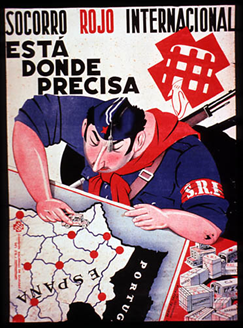
Socorro Rojo Poster
The Visual Front, UCSD (University of California Regents, 1998)
On the Front Lines
Dean arrived in Spain on July 11, 1937, and joined the Lincoln-Washington Battalionagainst Franco’s forces. He also joined the communist international aid organization, Socorro Rojo Internacional (“International Red Aid”), in Almansa in July of 1937 before heading to the front lines.
Founded in 1922 in the Soviet Union, the International Red Aid consisted of volunteers across the world providing relief aid to revolutionaries who, in their words, were subjected to “bourgeois class injustice.” The Spanish chapter, Socorro Rojo Internacional, provided important resources during the civil war, including networks that connected hospitals to the front lines, clinics, orphanages, refugee camps, and schools.
Dean’s involvement in Socorro Rojo strengthened his allegiance to leftist politics. He went to officers’ school, became a political delegate and, like Hans Maslowski and Ramón Pedrero Pérez, held the rank of sergeant. In his personnel file from December of 1938, he expressed his optimism towards the Popular Front of Spain, a political coalition of socialist and communist parties that defended working-class interests against fascism. Dean believed that they would “eventually win the war for the people and guarantee for the people of Spain a free [and] happy life.”
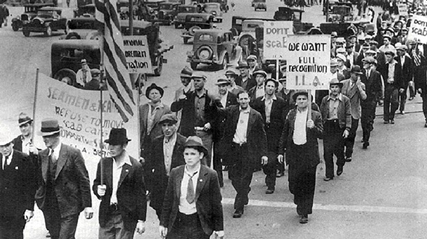
San Francisco Waterfront Strike, 1941
Found SF: The SF digital history archive
Dean was involved in multiple battles in Spain, including Fuentes de Ebro in October of 1937, in which the International Brigades launched a forceful attack against the Nationalists. He also fought in Teruel before the final battles of the Levante Offensive between February and August of 1938.
After Spain: Defeated but not Discouraged
While the Spanish Republic and the International Brigades were ultimately unsuccessful in defending Spain against the Nationalists, Dean maintained a positive image of the International Brigades. In his personnel file from December of 1938, he praised them for their “strong and heroic” actions and for “welding international solidarity and defending the Spanish frontiers.”
For Dean, the war marked an opportunity to protect the working class against fascism. Spain marked only the beginning of this fight. He returned to the United States in February of 1939. The following year he registered with the U.S. military as the country readied for World War II. He died in May of 1981 in Ohio.
FURTHER READINGS
“Socorro Rojo Internacional.” The Visual Front.
SOURCES
Criss Carlsson. “The Waterfront Strike.” FoundSF.
“Harold Dean.” Obituary. Cincinnati Post. 30 May 1981, p. 7.
“Harold F. Dean.” Personal File. RGASPI. Fond 545, Opis 6, File 879.
J. Martin Ryle. 1970. “International Red Aid and Comintern Strategy, 1922–1926.” International Review of Social History 15, no. 1, 43–68.