
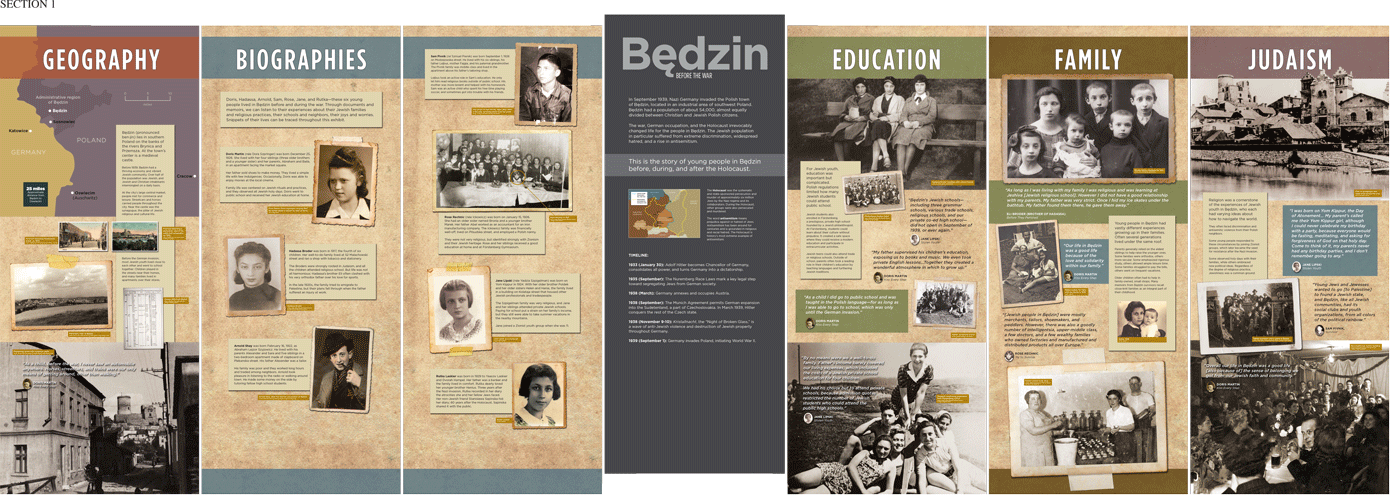
Before the War
Section 1 of the Traveling Exhibit
The city of Będzin is located in southwest Poland in Upper Silesia, sharing borders with the Czech Republic and Germany. The city was situated 25 miles northwest of Auschwitz-Birkenau. In the years leading up to World War 2, Będzin served as important center of agriculture, industry, and trade. Its population of about 54,000 inhabitants of diverse socio-economic backgrounds was composed of nearly equal parts Polish Jews and Polish Catholics. The two communities lived in relatively harmonious coexistence with layers of intercommunal relations. However, antisemitism and anti-Judaism were embedded in parts of Polish culture and society, marking the daily life of Jews in Będzin.
Religion, family, and education were the cornerstones of everyday life experienced by the Jewish youth of Będzin. Different educational paths were available: they attended secular Polish, vocational, or religious schools. People practiced the Jewish religion and culture in various ways. Some remained loyal to Judaism in its orthodox form, others lived their Jewish traditions more liberally, or embraced Zionism and other political ideals. Regardless of such diversity, the Great Synagogue of Będzin functioned as a center of the Jewish community. It was among the first targets of the Nazis when they occupied the city in early September of 1939.
In order to understand the devastation brought upon by the war and the Holocaust, and especially on young people, it is important to learn more about Jewish life before the German occupation of Będzin.
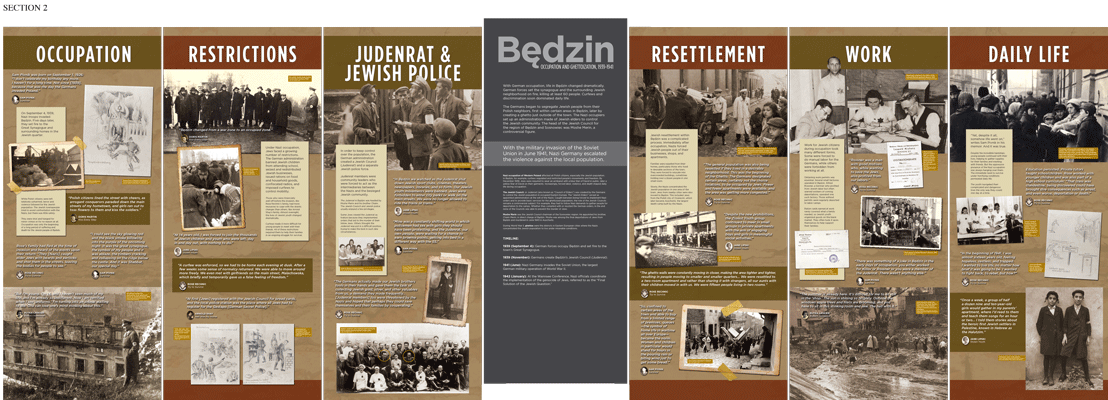
Occupation & Ghettoization
Section 2 of Traveling Exhibit
With German occupation, life in Będzin changed dramatically. Several days after occupation of the town, German forces set the Great Synagogue and the surrounding Jewish neighborhood on fire, killing at least sixty people. Curfews and discrimination soon dominated daily life.
The Germans soon began to segregate Jewish people from their Polish neighbors, first within certain areas of Będzin, later by creating a Jewish ghetto (Kamionka) just outside of town. The Nazi occupiers also set up an administration made of Jewish elders, called the Jewish Council, or Judenrat. Their Nazi-enforced task was to oversee the Jewish community and help implement various measures. Squads of Jewish ghetto police aided the Councils by assisting the Nazi orders to round up and terrorize their fellow Jews. The head of the Jewish council for the region of Będzin and the nearby city of Sosnowiec was Moshe Merin, a controversial figure.
With the military invasion of the Soviet Union in June 1941, Nazi Germany escalated the violence against the local population
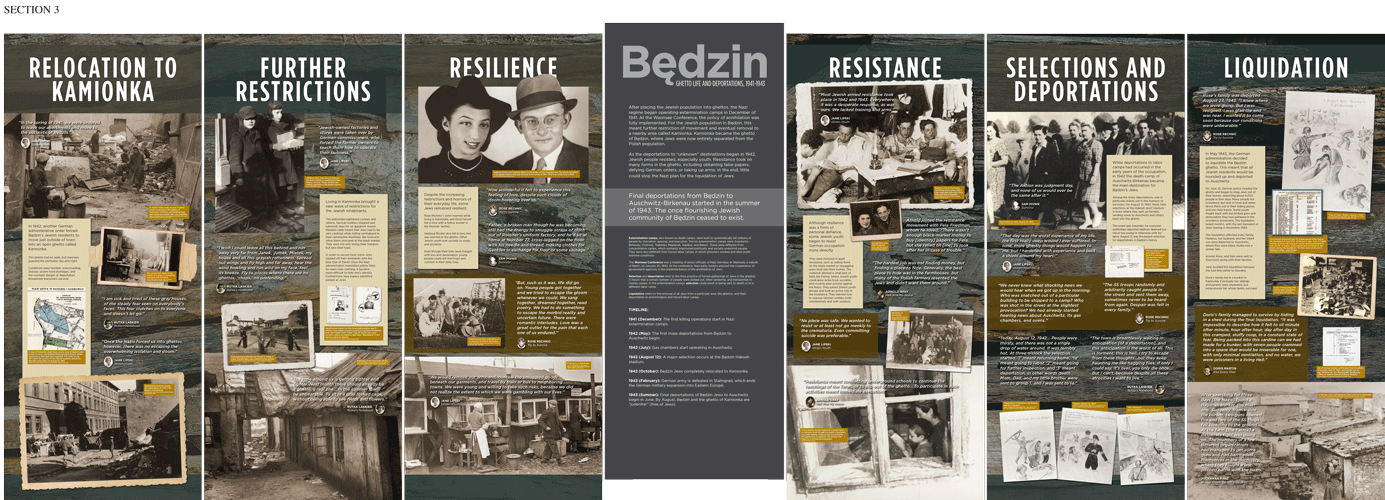
Ghetto Life
Section 3 of Traveling Exhibit
After placing the Jewish population into ghettos, the Nazi regime began operating extermination camps in December of 1941. At the Wannsee Conference, the policy of annihilation was fully implemented. Plans for the Final Solution to what the Nazi called “the problem of European Jewry” were created and new restrictions on Jewish life quickly spread through Nazi-occupied Europe. For the Jewish population of Będzin, this meant further constraints on everyday life and eventual removal to a nearby area called Kamionka. Kamionka became Będzin’s ghetto, where Jews were now entirely separated from the Polish population.
Life in the ghetto was harsh. Residents were subjected to poor living conditions, food shortages, a lack of medical care, and the constant physical abuse. As a result, disease and starvation ran rampant in the ghetto. Nazis forced many Jews into manual and slave labor and enforced harsh restrictions and curfews. Jewish social engagements and cultural traditions were all but silenced and generally moved into the privacy of homes or underground.
Despite the bleakness of ghetto life, residents carried on with their lives. As the deportations to “unknown” destinations began in 1942, some Jewish people resisted, especially youth. Resistance took on many forms in the ghetto, including obtaining false papers, defying German orders, or taking up arms. Many Jews formed underground social and resistance groups to fight back against the Nazi perpetrators. In the end, little could stop the Nazi plan for the mass killings of Jews.
Final liquidation of the Będzin ghetto and its occupants began in 1943. Nazi officials sent most Jewish residents of Będzin to nearby Auschwitz-Birkenau where they were either killed upon arrival or selected for labor inside the camp or in one of its satellite factories. About fifty Jews remained in Będzin to work in tailor shops, while a few hid in the Kamionka ghetto. Once caught, those in hiding were forced to clean up the ghetto, then sent to their death in Auschwitz.
Final deportations from Będzin to Auschwitz-Birkenau began in the summer of 1943. The once-flourishing Jewish community of Będzin ceased to exist.