
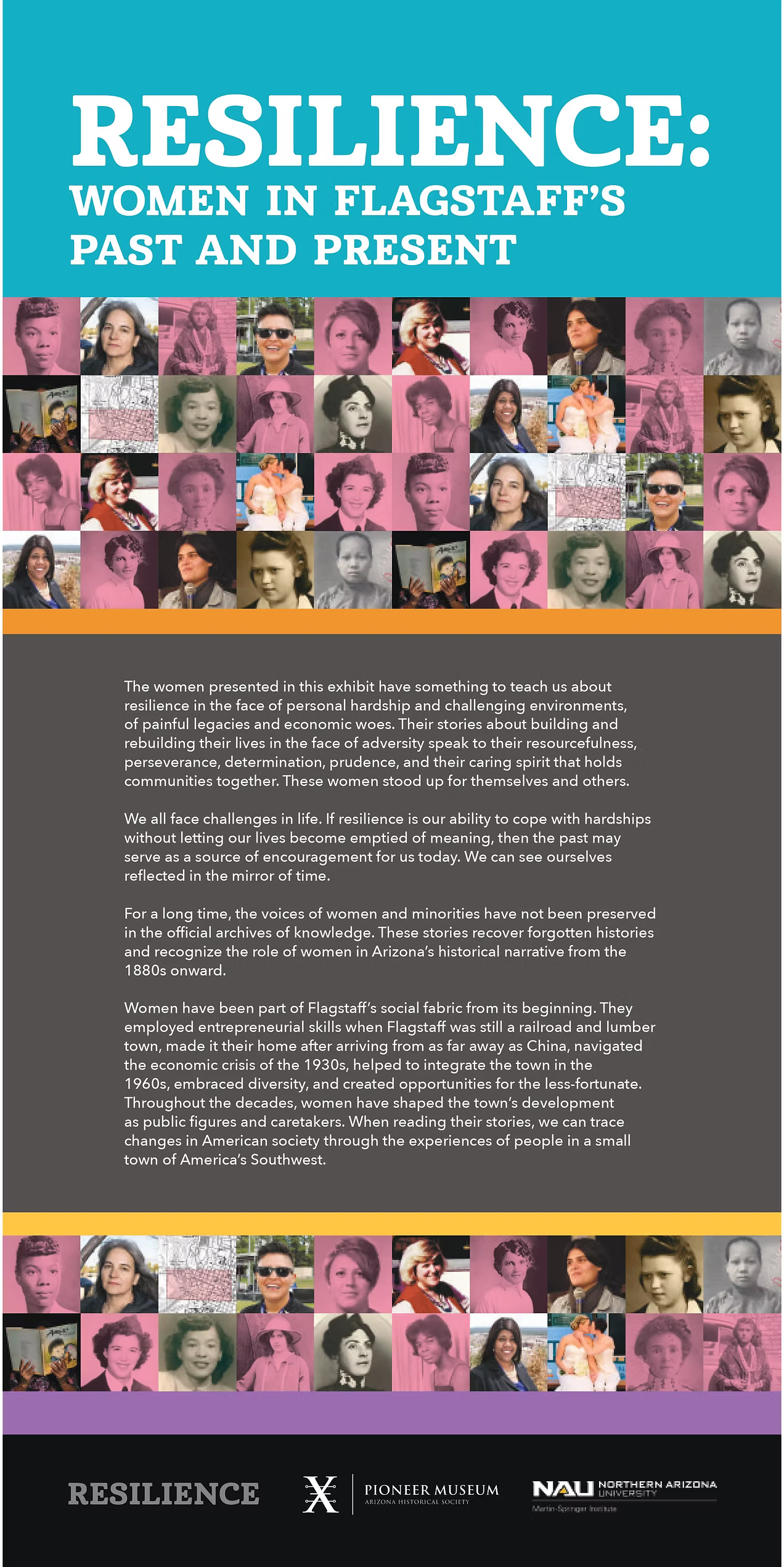
Women in Flagstaff’s Past and Present
Panel 1:
The women presented in this exhibit have something to teach us about resilience in the face of personal hardship and challenging environments, of painful legacies and economic woes.
Their stories about building and rebuilding their lives in the face of adversity speak to their resourcefulness, perseverance, determination, prudence, and their caring spirit that holds communities together. These women stood up for themselves and others.
We all face challenges in life. If resilience is our ability to cope with hardships without letting our lives become emptied of meaning, then the past may serve as a source of encouragement for us today. We can see ourselves reflected in the mirror of time.
For a long time, the voices of women and minorities have not been preserved in the official archives of knowledge. These stories recover forgotten histories and recognize the role of women on Arizona’s historical narrative from the 1880’s onward.
Women have been part of Flagstaff’s social fabric from its beginning. They employed entrepreneurial skills when Flagstaff was still a railroad and lumber town, made it their home after arriving from as far away as China, navigated the economic crisis of the 1930’s, helped to integrate the town in the 1960’s, embraced diversity, and created opportunities for the less-fortunate.
Throughout the decades, women have shaped the town’s development as public figures and caretakers. When reading their stories, we can trace changes in American society through the experiences of people in a small town in America’s Southwest.
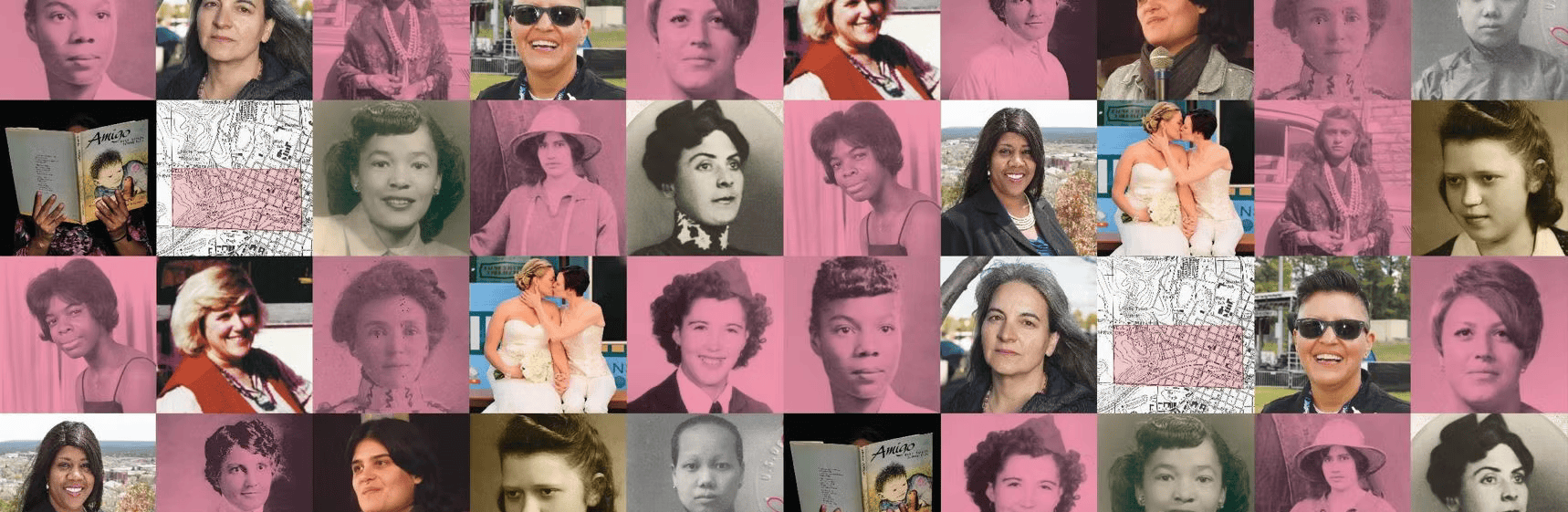
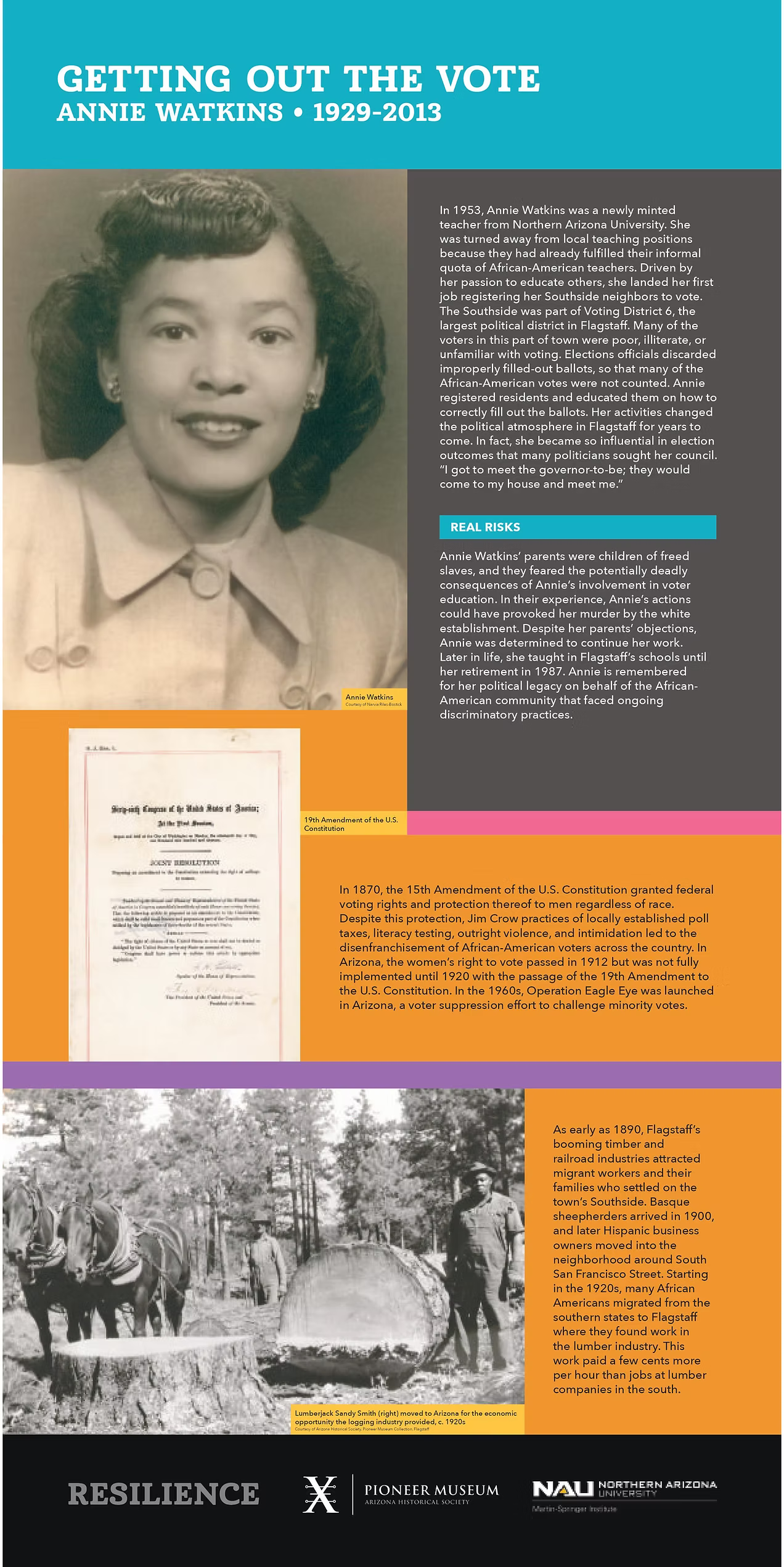
Getting Out the Vote
Annie Watkins
1929 - 2013
In 1953 Annie Watkins was a newly minted teacher from Northern Arizona University. She was turned away from local teaching positions because they had already fulfilled their informal quota of African American teachers.
Driven by her passion to educate others, she landed her first job registering her Southside neighbors to vote.
The Southside was part of Voting District 6, the largest political district in Flagstaff. Many of the voters in this part of town were poor, illiterate, or unfamiliar with voting. Elections officials discarded improperly filled out ballots, so that many of the African-American votes were not counted.
Annie registered residents and educated them on how to correctly fill out the ballots. Her activities changed the political atmosphere in Flagstaff for years to come. In fact, she became so influential in election outcomes that many politicians sought her council. “I got to meet the governor-to-be; they would come to my house and meet me.”
REAL RISKS
Annie Watkins’ parents were children of freed slaves, and they feared the potentially deadly consequences of Annie’s involvement in voter education. In their experience, Annie’s actions could have provoked her murder by the white establishment. Despite her parents’ objections, Annie was determined to continue her work.
Later in life, she taught in Flagstaff’s schools until her retirement in 1987. Annie is remembered for her political legacy on behalf of the African-American community that faced ongoing discriminationory practices.
19th AMENDMENT TO THE U.S. CONSTITUTION
In 1870 the 15th Amendment to the US Constitution granted federal voting rights and protection thereof to men regardless of race. Despite this protection, Jim Crow practices including locally established poll taxes, literacy testing, outright violence, and intimidation led to the disenfranchisement of African-American voters across the country.
In Arizona the women’s right to vote passed in 1912 but was not fully implemented until 1920 with the passage of the 19th Amendment to the U.S. Constitution.
In the 1960’s, operation Eagle Eye, a voter suppression effort to challenge minority votes, was launched in Arizona.
As early as 1890, Flagstaff’s booming timber and railroad industries attracted migrants workers and their families. They settled on the town’s Southside. Basque sheepherders arrived in 1900, and later Hispanic business owners moved into the neighborhood around South San Francisco Street. Starting in the 1920’s, many African-Americans migrated from the southern states to Flagstaff, where they found work in the lumber industry. This work paid a few cents more per hour than jobs at lumber companies in the south.
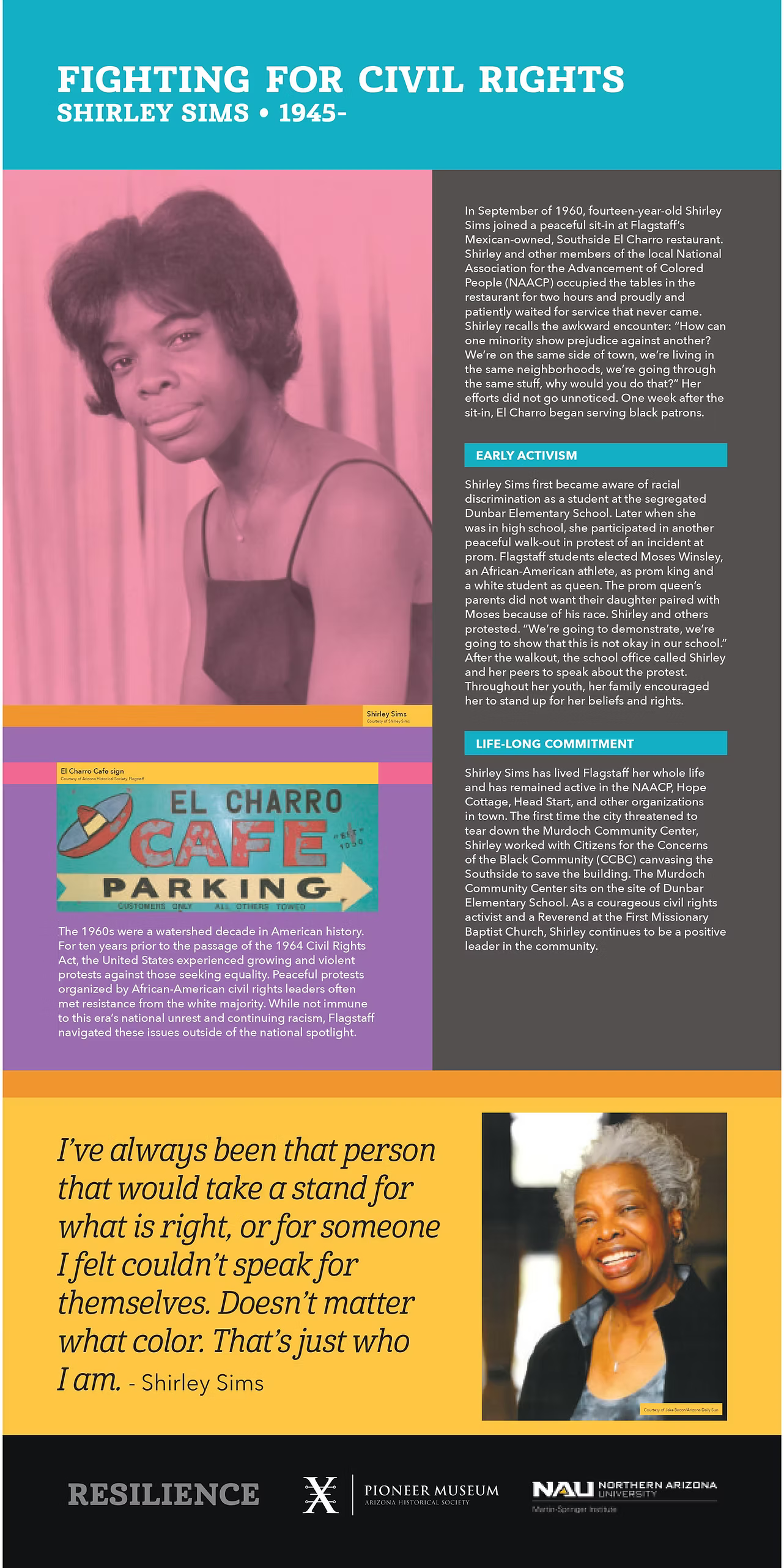
Fighting for Civil Rights
Shirley Sims
1945 -
In September of 1960, fourteen-year-old Shirley Sims joined a peaceful sit-in at Flagstaff’s Mexican-owned, Southside El Charro restaurant. Shirley and other members of the local National Association for the Advancement of Colored People (NAACP) occupied the tables in the restaurant for two hours and proudly and patiently waited for service that never came.
Shirley recalls the awkward encounter: “How can one minority show prejudice against another? We’re on the same side of town, we’re living in the same neighborhoods, we’re going through the same stuff, why would you do that?”
Her efforts did not go unnoticed. One week after the sit-in, El Charro began serving black patrons.
EARLY ACTIVISM
Shirley Sims first became aware of racial discriminations as a student at the segregated Dunbar Elementary School. Later when she was in High School, she participated in another peaceful walkout protesting an incident at prom.
Flagstaff students selected Moses Winsley, an African-American athlete, as prom king and a white student as queen.
The prom queen’s parents did not want their daughter paired with Moses because of his race. Shirley and others protested. “We’re going to demonstrate, we’re going to show that this is not okay in our school.” After the walkout, the school office called Shirley and her peers to speak about the protest. Throughout her youth, her family encouraged her to stand up for her beliefs and rights.
LIFE-LONG COMMITMENT
Shirley Sims has lived in Flagstaff her whole life and has remained active in the NAACP, Hope Cottage, Head Start, and other organizations in town. The first time the city threatened to tear down the Murdoch Community Center, Shirley worked with Citizens for the Concerns of the Black Community (CCBC) canvassing the Southside to save the building. (The Murdoch Community Center sits on the site of the Dunbar Elementary School) As a courageous civil rights activist and a Reverend at the First Missionary Baptist Church, Shirley continues to be a positive leader in the community.
The 1960’s
The 1960’s were a watershed decade in American History. For ten years prior to the passage of the 1964 Civil Rights Act, the United States experienced growing and violent protests against those seeking equality. Peaceful protests organized by African-American civil rights leaders often met resistance from the white majority. While not immune to this era’s national unrest and continuing racism, Flagstaff navigated these issues outside of the national spotlight.
Quote from Sims:
“I’ve always been that person that would take a stand for what is right, or for someone I felt couldn’t speak for themselves. Doesn’t matter what color. That’s just who I am.”
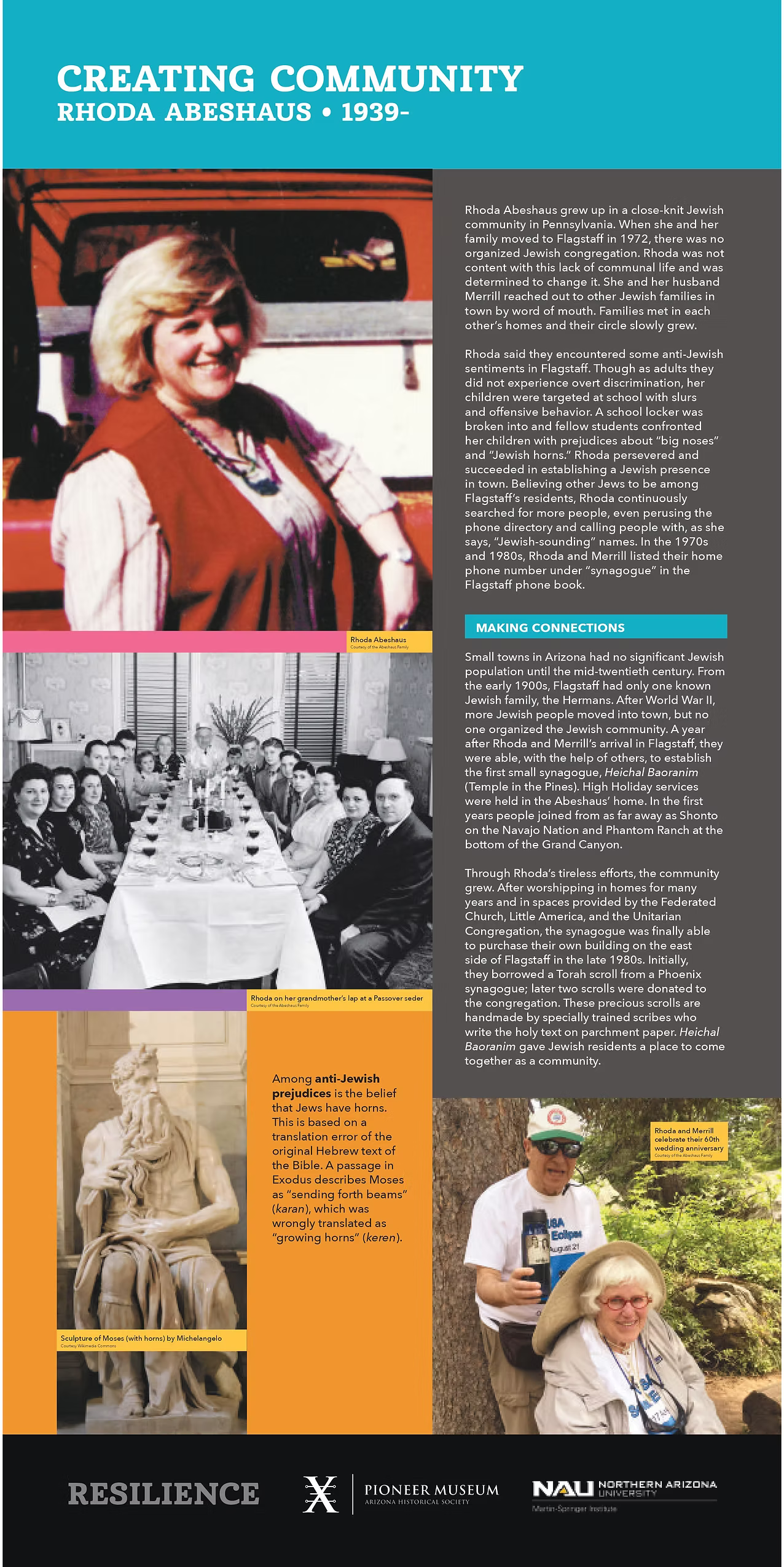
Creating Community
Rhoda Abeshaus
1939 -
Rhoda Abeshaus grew up in a close-knit Jewish community in Pennsylvania. When she and her family moved to Flagstaff in 1972, there was no organized Jewish congregation. Rhoda was not content with the lack of communal life and was determined to change it. She and her husband, Merrill, reached out to other Jewish families in town by word of mouth. Families met in each others’ homes and their circle slowly grew.
Rhoda said they encountered some anti-Jewish sentiments in Flagstaff. Though as adults they did not experience overt discrimination, her children were targeted at school with slurs and offensive behavior. A school locker was broken into, and fellow students confronted her children with prejudices about “big noses” and “Jewish horns.”
Rhoda persevered and succeeded in establishing a Jewish presence in town. Believing other Jews to be among Flagstaff’s residents, Rhoda continuously searched for more people even perusing the phone directory and calling people with, as she says, “Jewish-sounding” names. In the 1970’s and 1980’s, Rhoda and Merrill listed their home phone number under “synagogue“ in the Flagstaff phone book.
MAKING CONNECTIONS
Small towns in Arizona had no significant Jewish population until the mid-twentieth century. From the early 1900’s, Flagstaff had only one known Jewish family, the Hermans.
After World War II, more Jewish people moved into town, but no one organized the Jewish community.
A year after Rhoda and Merrill’s arrival in Flagstaff, they were able, with the help of others, to establish the first small synagogue, Heichal Baoranim (Temple in the Pines). High Holidays services were held in the Abeshaus’ home. In the first years, people joined from as far away as Shonto, on the Navajo Nation, and Phantom Ranch, at the bottom of the Grand Canyon.
Through Rhoda’s tireless efforts, the community grew. After worshipping in homes for many years and in spaces provided by the Federated Church, Little America, and the Unitarian Congregation, the synagogue was finally able to purchase their own building on the east side of Flagstaff in the late 1980’s.
Initially, they borrowed a Torah scroll from a Phoenix synagogue; later two scrolls were donated to the congregation. These precious scrolls are handmade by specially trained scribes who write the holy text on parchment paper. Heichal Baoranim gave Jewish residents a place to come together as a community.
Jewish horns?
Among anti-Jewish prejudices is the belief that Jews have horns. This is based on a translation error of the original Hebrew text of the Bible. A passage in Exodus describes Moses as, “sending forth beams,” (Karan) which was wrongly translated as, “growing horns,” (keren). Michelangelo’s famous sculpture of Moses includes horns.
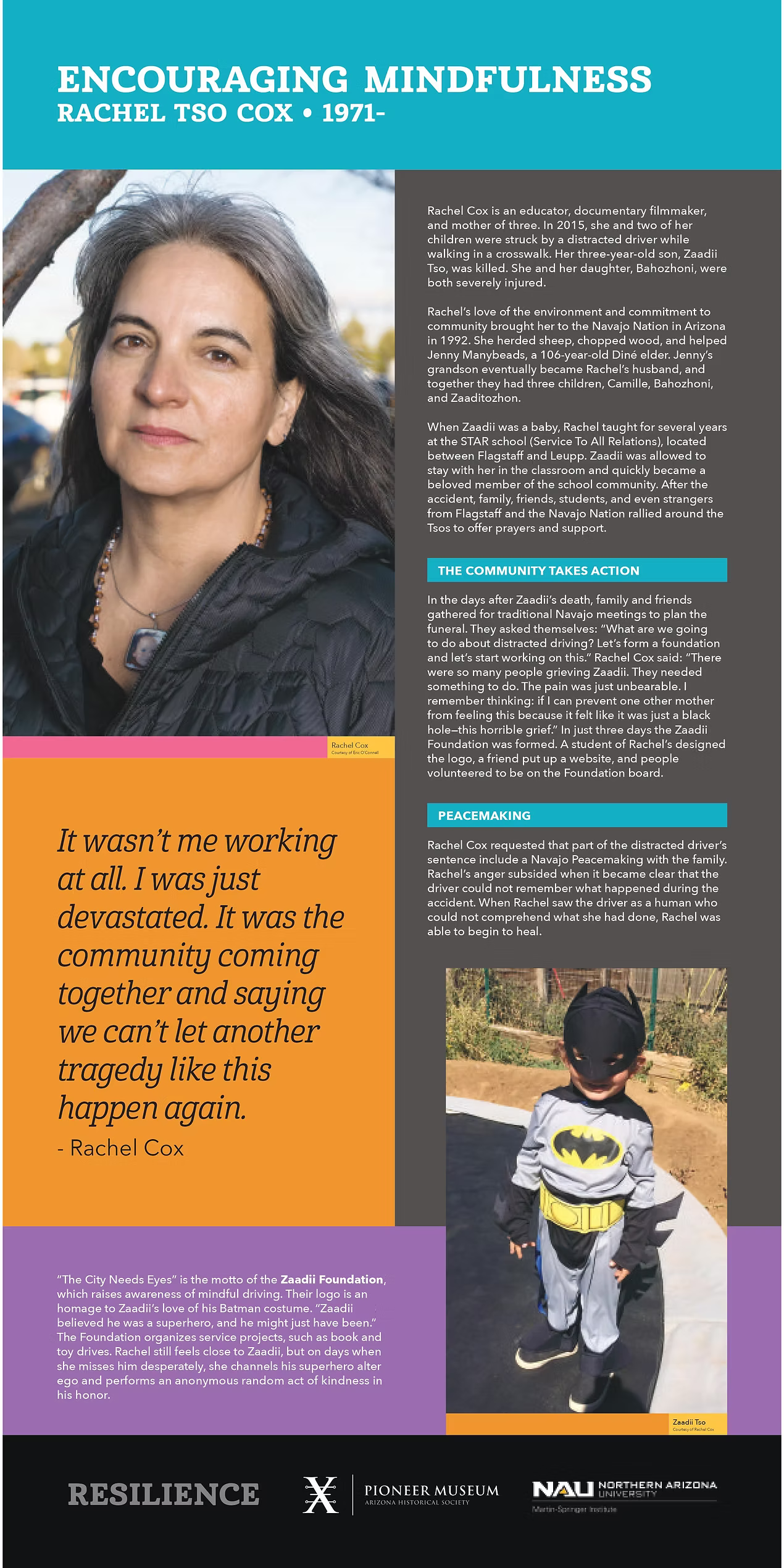
Encouraging Mindfulness
Rachel Tso Cox
1971 -
Rachel Cox is an educator, documentary filmmaker, and mother of three. In 2015, she and two of her children were struck by a distracted driver while walking in a crosswalk. Her three-year-old son, Zaadii Tso, was killed. She and her daughter, Bahozhoni, were both severely injured.
Rachel’s love of the environment and commitment to community brought her to the Navajo Nation in 1992. She herded sheep, chopped wood, and helped Jenny Manybeads, a 106-year-old Diné elder. Jenny’s grandson eventually became Rachel’s husband, and together they had three children, Camille, Bahozhoni, and Zaaditozhon.
When Zaadii was a baby, Rachel taught for several years at STAR school (Service To All Relations) located between Flagstaff and Leupp. Zaadii was allowed to stay with her in the classroom and quickly became a beloved member of the school community. After the accident, family, friends, students, and even strangers from Flagstaff and the Navajo Nation rallied around the Tsos to offer prayers and support.
THE COMMUNITY TAKES ACTION
In the days after Zaadii’s death, family and friends gathered for the traditional Navajo meetings to plan the funeral. They asked themselves: “What are we going to do about distracted driving? Let’s form a foundation and let’s start working on this.”
Rachel said, “There were so many people grieving Zaadii. They needed something to do. The pain was just unbearable. I remember thinking, if I can prevent one other mother from feeling this —because it felt like it was just a black hole—this horrible grief.”
In just three days the Zaadii foundation was formed. A student of Rachel’s designed the logo, a friend put up the website, and people volunteered to be on the foundation board.
PEACEMAKING
Rachel requested that part of the distracted driver’s sentence include a Navajo Peacemaking with the family. Her anger subsided when it became clear that the driver could not remember what happened during the accident. When she saw the driver as a human who could not comprehend what she had done, Rachel was able to begin to heal.
A Quote from Rachel:
“It wasn’t me working at all. I was just devastated. It was the community coming together and saying, we can’t let another tragedy like this happen again.”
THE ZAADII FOUNDATION
“The City Needs Eyes” is the motto of the Zaadii Foundation, which raises awareness of mindful driving. Their logo is an homage to Zaadii’s love of his Batman costume. Zaadii believed he was a superhero, and he just might have been. The foundation organizes service projects, such as book and toy drives.
Rachel still feels close to Zaadii, but on days when she misses him desperately, she channels her superhero alter ego and performs an anonymous random act of kindness in his honor.

Battling For Equality
Meagan and Natalie Metz
1984 -
When Meagan and Natalie met in Flagstaff in 2007, they did not imagine that their commitment would change Arizona’s law on marriage equality. All they knew was that they were perfect for one another. They deeply loved each other and wanted to marry, but the State of Arizona would not issue them a license. When the State of Washington legalized same-sex marriage in 2012, they took advantage of it in Seattle, where Meagan had previously lived.
Shortly after their wedding, Meagan was diagnosed with Ehlers-Danos Syndrome, a serious genetic connective tissue disorder. As a same-sex couple in Arizona, they were denied the legal protections that come with marriage. Tired of waiting for the state to change, they were ready to move away from Flagstaff. One night their friend and local attorney, Ryan Steves, said, “You can jump ship and go somewhere else, or you can stay and fight and change the state not just for yourselves, but for everyone else here.”
HEALTH AND LEGAL STRUGGLES
Both Natalie and Meagan were born in 1984, Natalie in Hammond, Indiana, and Meagan in Salt Lake City, Utah.
Natalie came to Flagstaff in 2003 to study at Northern Arizona University. Meagan fell in love with the city when, one summer, she visited her sister in Flagstaff. Growing up in The Church of Jesus Christ of Latter-Day Saints, it was difficult to come out as a a lesbian, and Meagan was ostracized by her community and family. With time she was able to rebuild relationships with family and make new friends in Flagstaff’s LGBTQ community, including Natalie, who later became her wife.
Flagstaff Medical Center offered Domestic Partnership benefits before gay marriage became legal in Arizona; Meagan was also able to get on Natalie’s insurance. But uncertainties and fears lingered. “When we would go to Phoenix for different doctor appointments without legal protection, you are at the mercy of whoever the person is.”
With their attorney’s assistance, they joined the Connolly v. Roche same-sex marriage case with other couples from Phoenix and Tucson, which went all the way to a federal court. Meagan and Natalie applied for a marriage license at the Coconino County Courthouse, but they were rejected—an important stepping stone towards the eventual success of the case.
On October 17, 2014, the court ruled same-sex marriage legal in Arizona. Since that year, Meagan and Natalie have worked with Flagstaff Pride and supported the LGBTQ community.
Natalie is currently finishing her doctorate, and Meagan continues to take care of her health. “Life gets a little chaotic at times,” they say. But with their love unbroken, they see a bright future ahead, together.
Quote from Meagan and Natalie:
“We wanted legal marriage because we wanted our commitment to be recognized by the law. We wanted our partnership to be legally accepted as a binding agreement that came with all the rights and privileges afforded to other couples. We wanted the safety and respect of legal marriage because it establishes a sense of protection in otherwise unpredictable circumstances. We wanted the right to be seen and accepted exactly as we are.”
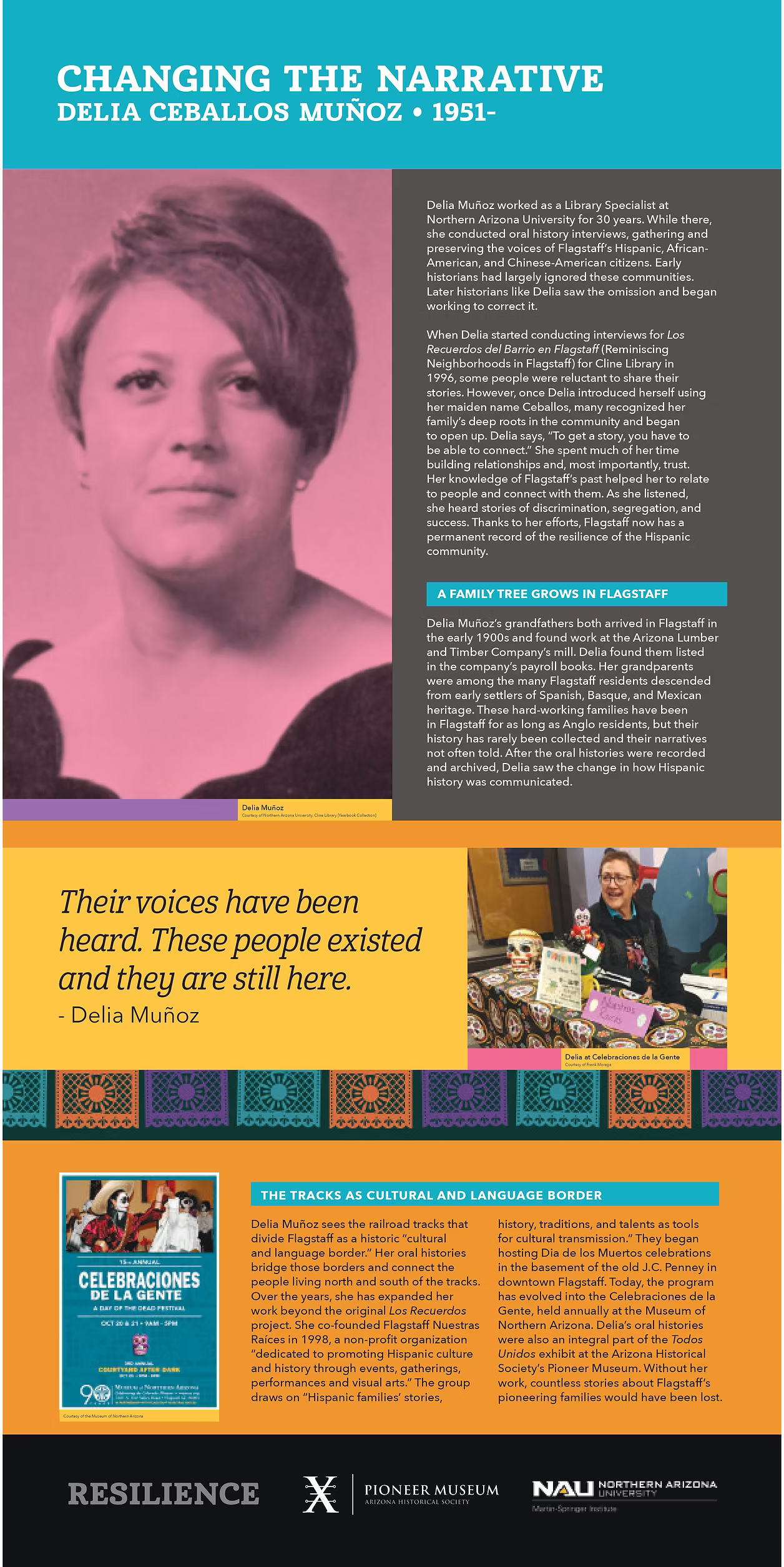
Changing the Narrative
Delia Ceballos Muñoz
1951 -
Delia Muñoz worked as a Library Specialist at Northern Arizona University for 30 years. While there she conducted oral history interviews, gathering and preserving the voices of Flagstaff’s Hispanic, African-American and Chinese-American citizens. Early historians had largely ignored these communities. Later historians, like Delia, saw the omission and began working to correct it.
When Delia started conducting interviews for Los Recuerdos del Barrio en Flagstaff (Reminiscing Neighborhoods in Flagstaff) for Cline Library in 1996, some people were reluctant to share their stories. However, once Delia introduced herself using her maiden name, Ceballos, many recognized her family’s deep roots in the community and began to open up.
Delia says, “To get a story, you have to be able to connect.” She spent much of her time building relationships and, more importantly, trust. Her knowledge of Flagstaff’s past helped her to relate to people and connect with them. As she listened, she heard stories of discrimination, segregation, and success. Thanks to her efforts, Flagstaff now has a permanent record of the resilience of the Hispanic community.
A FAMILY TREE GROWS IN FLAGSTAFF
Delia Muñoz’s grandfathers both arrived in Flagstaff in the early 1900’s and found work at the Arizona Lumber and Timber Company’s mill. Delia found them listed in the company’s payroll books. Her grandparents were among the many Flagstaff residents descended from early settlers of Spanish, Basque, and Mexican heritage. These hard-working families have been in Flagstaff for as long as Anglo residents, but their history has rarely been collected and their narratives not often told. After the oral histories were recorded and archived, Delia saw a change in how Hispanic history was communicated.
THE TRAIN TRACKS AS CULTURAL AND LINGUISTIC BORDER
Delia Muñoz sees the railroad tracks that divide Flagstaff as a historic cultural and language border. Her oral histories bridge those borders and connect the people living North and South of the tracks.
Over the years, she has expanded her work beyond the original Los Recuerdos project. She co-founded Flagstaff Nuestras Raices in 1998, a non-profit organization dedicated to promoting Hispanic culture and history through events, gatherings, performances, and visual arts. The group draws on Hispanic families’ stories, history, traditions, and talents as tools for cultural transmission.
They began hosting Dia de los Muertos celebrations in the basement of the old J.C. Penney in downtown Flagstaff.
Today, the program has evolved into the Celebraciones de la Gente, held annually at the Museum of Northern Arizona. Delia’s oral histories were also an integral part of the Todos Unidos exhibit at the Arizona Historical Society’s Pioneer Museum. Without her work, countless stories about Flagstaff’s pioneering families would have been lost.
Quote from Delia:
“Their voices have been heard. These people existed and they are still here.”
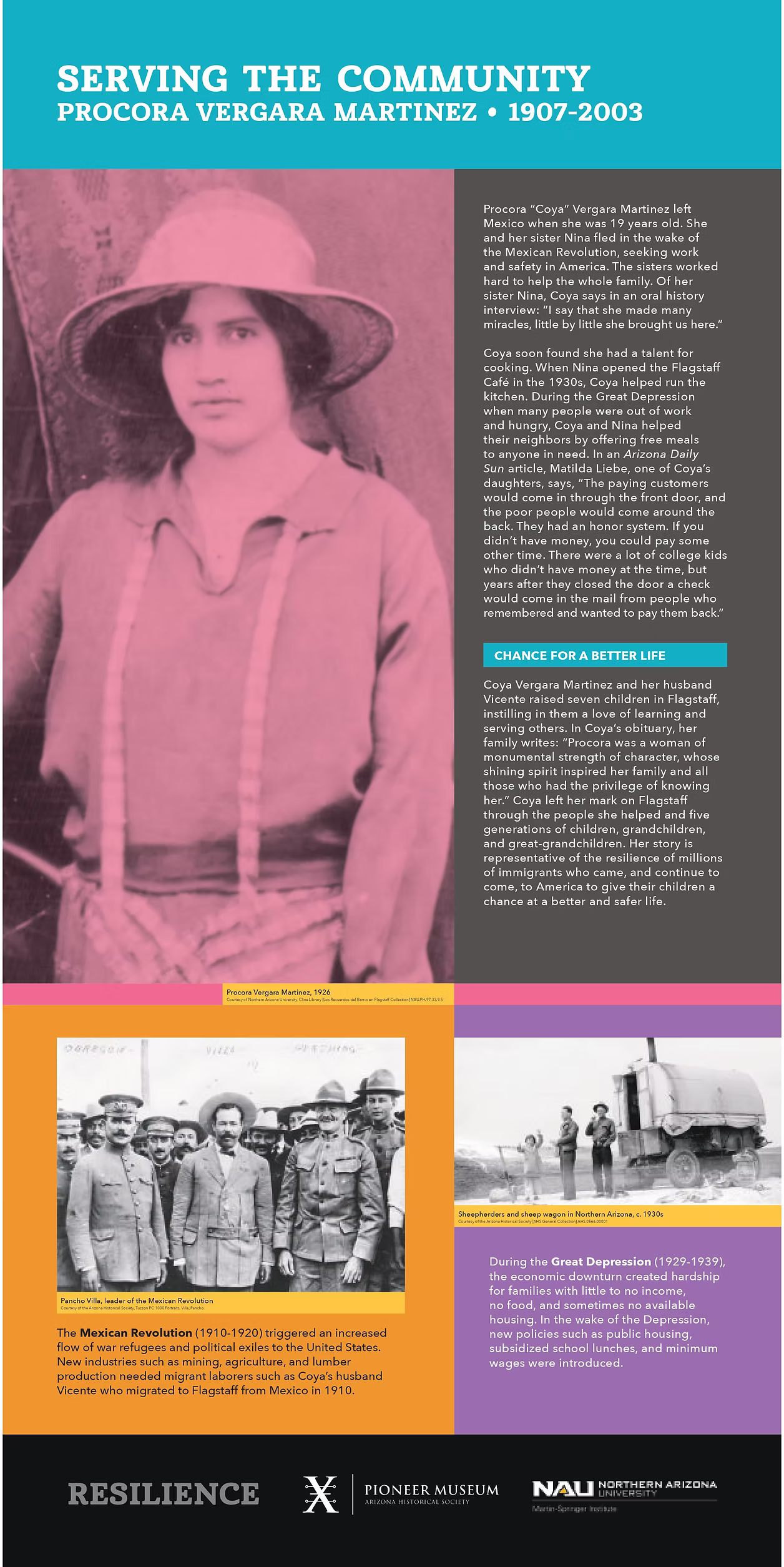
Serving the Community
Procora Vergara Martinez
1907 - 2003
Procora “Coya” Vergara Martinez left Mexico when she was 19 years old. She and her sister, Nina, fled in the wake of the Mexican Revolution, seeking work and safety in America. The sisters worked hard to help the whole family. Of her sister Nina, Coya says in an oral history interview, “I say that she made many miracles, little by little she brought us here.”
Coya soon found she had a talent for cooking. When Nina opened the Flagstaff Café in the 1930’s, Coya helped run the kitchen. During the Great Depression when many people were out of work and hungry, Coya and Nina helped their neighbors by offering free meals to anyone in need.
In an Arizona Daily Sun Article, Matilda Liebe, one of Coya’s daughters, says, “The paying customers would come in through the front door and the poor people would come around the back. They had an honor system. If you didn’t have money, you could pay some other time. There were a lot of college kids who didn’t have money at the time, but years after they closed the door a check would come in the mail from people who remembered and wanted to pay them back.”
CHANCE FOR A BETTER LIFE
Coya Vergara Martinez and her husband, Vicente, raised seven children in Flagstaff, instilling in them a love of learning and serving others. In Coya's obituary, her family writes: "Procora was a woman of monumental strength of character, whose shining spirit inspired her family and all those who had the privilege of knowing her." Coya left her mark on Flagstaff through the people she helped and five generations of children, grandchildren, and great-grandchildren. Her story is representative of the resilience of millions of immigrants who came, and continue to come, to America to give their children a chance at a better and safer life.
THE GREAT DEPRESSION
The Great Depression (1929 - 1939) created hardship for families with little to no income, no food, and sometimes no available housing. In the wake of the Depression, new policies such as public housing, subsidized school lunches, and minimum wages were introduced.
THE MEXICAN REVOLUTION
The revolution lasted from 1910 - 1920 and triggered an increased flow of war refugees and political exiles in the United States. New industries such as mining, agriculture, and lumber production needed migrant laborers such as Coya’s husband, Vicente, who migrated to Flagstaff from Mexico in 1910.
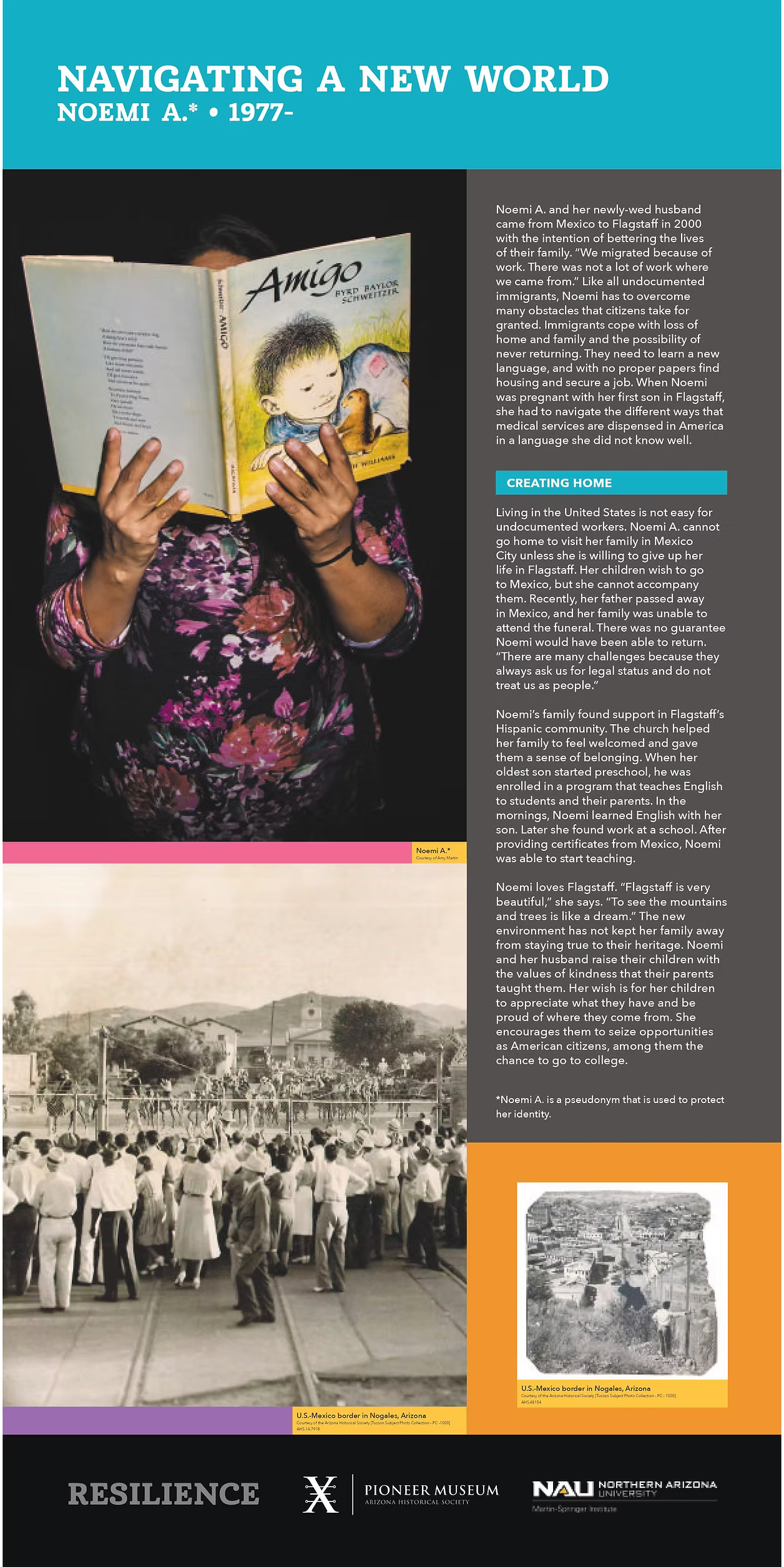
Navigating a New World
Noemi A.*
1977 -
Noemi A. and her newly-wed husband came from Mexico to Flagstaff in 2000 with the intention of bettering the lives of their family.
“We migrated because of work. There was not a lot of work where we came from.”
LIke all undocumented immigrants, Noemi has to overcome many obstacles that citizens take for granted. Immigrants cope with loss of home and family, and the possibility of never returning. They need to learn a new language, and find housing and secure a job without proper papers. When Noemi was pregnant with her first son in Flagstaff, she had to navigate different ways that medical service are dispensed in America in a language she did not know well.
CREATING HOME
Living in the United States is not easy for undocumented workers. Noemi cannot go home to visit her family in Mexico City unless she is willing to give up her life in Flagstaff. Her children wish to go to Mexico, but she cannot accompany them. Recently her father passed away in Mexico, and her family was unable to attend the funeral. There was no guarantee Noemi would have been able to return.
“There are challenges because they always ask us for legal status and do not treat us as people.”
Noemi’s family found support in Flagstaff’s Hispanic community. The church helped her family feel welcome and gave them a sense of belonging. When her oldest son started preschool, he was enrolled in a program that teaches English to students and their parents. In the mornings, Noemi learned English with her son, later she found work at a school. After providing certificates from Mexico, Noemi was able to start teaching.
Noemi loves Flagstaff. “Flagstaff is very beautiful,” she says. “To see the mountains and trees is like a dream.”
The new environment has not kept her family from staying true to their heritage. Noemi and her husband raise their children with the values of kindness that their parents taught them. Her wish is for her children to appreciate what they have and be proud of where they come from. She encourages them to seize opportunities as American citizens, among them the chance to go to college.
*Noemi A. is a pseudonym used to protect her identity
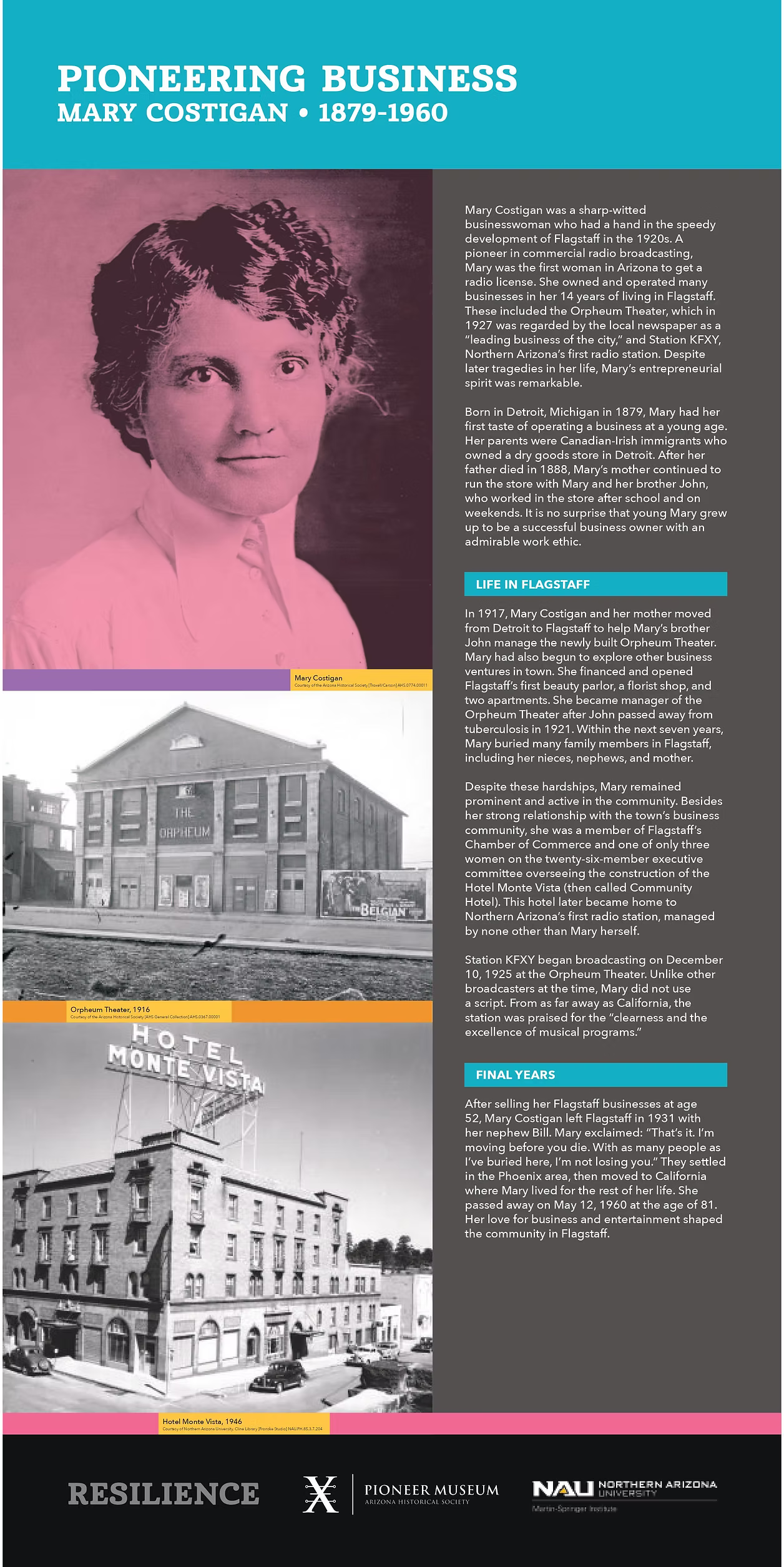
Pioneering Business
Mary Costigan
1879 - 1960
Mary Costigan was a sharp-witted businesswoman who had a hand in the speedy development of Flagstaff in the 1920’s. A pioneer in commercial radio broadcasting, Mary was the first woman in Arizona to get a radio license. She owned and operated many businesses in her 14 years of living in Flagstaff. These included the Orpheum Theatre, which in 1927 was regarded by the local newspaper as a, “leading business of the city,” and Station KFXY, Northern Arizona’s first radio station. Despite later tragedies in her life, Mary’s entrepreneurial spirit was remarkable.
Born in Detroit, Michigan in 1879, Mary had her first taste of operating a business at a young age. Her parents were Canadian-Irish immigrants who owned a dry goods store in Detroit. After her father died in 1888, Mary’s mother continued to run the store with Mary and her brother, John, who worked in the store after school and on weekends. It is no surprise that young Mary grew up to be a successful business owner with an admirable work ethic.
LIFE IN FLAGSTAFF
In 1917, Mary Costigan and her mother moved from Detroit to Flagstaff to help Mary’s brother, John manage the newly built Orpheum Theatre. Mary had also begun to explore other business ventures in town. She financed and opened Flagstaff’s first beauty parlor, a florist shop, and two apartments. She became manager of the Orpheum Theatre after John passed away from tuberculosis in 1921. Within the next seven years, Mary buried many family members in Flagstaff, including her nieces, nephews, and mother.
Despite these hardships, Mary remained prominent and active in the community. Besides her strong relationship with the town’s business community, she was a member of the Chamber of Commerce, one of only three women on the twenty-six member executive committee overseeing the construction of the Hotel Monte Vista (then called Community Hotel). This hotel later became home to Northern Arizona’s first radio station, managed by none other than Mary herself.
Station KFXY began broadcasting on December 10, 1925, at the Orpheum Theatre. Unlike other broadcasters of the time, Mary did not use a script. From as far away as California, the station was praised for “the clearness and the excellence of musical programs.”
FINAL YEARS
After selling her Flagstaff businesses at age 52, Mary Costigan left Flagstaff in 1931 with her nephew, Bill. Mary exclaimed: “That’s it. I’m moving before you die. With as many people as I’ve buried here, I’m not losing you.”
They settled in the Phoenix area, then moved to California where Mary lived for the rest of her life.
She passed away on May 12, 1960, at the age of 81. Her love for business and entertainment shaped the community of Flagstaff.
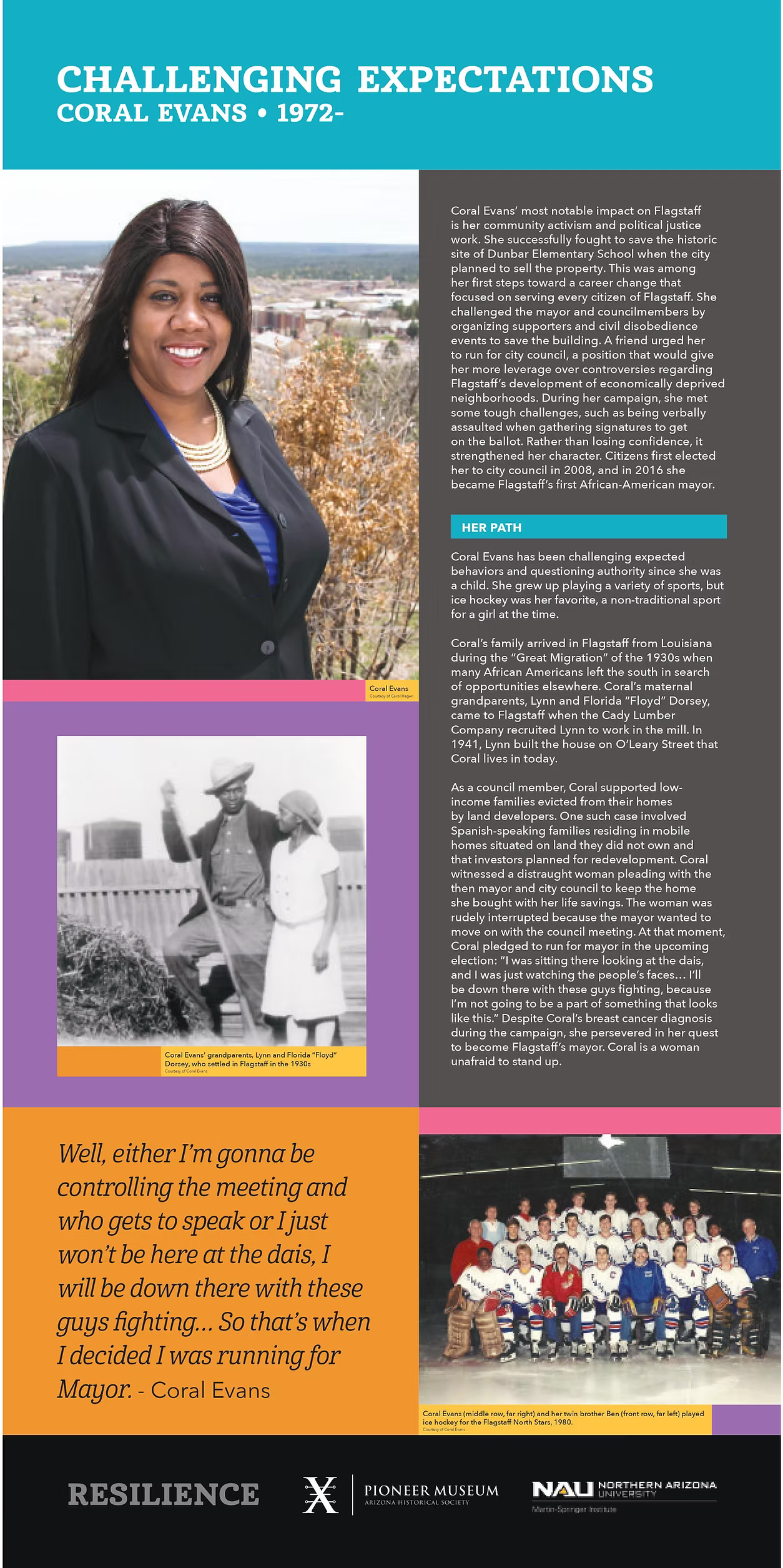
Challenging Expectations
Coral Evans
1972 -
Coral Evans’ most notable impact on Flagstaff is her community activism and political justice work.
She successfully fought to save the historic Dunbar Elementary School when the city planned to sell the property. This was among her first steps toward a career change that focused on serving every citizen of Flagstaff. She challenged the mayor and council members by organizing supporters and civil disobedience events to save the building.
A friend urged her to run for city council, a position that would give her more leverage over controversies regarding Flagstaff’s development of economically deprived neighborhoods.
During her campaign, she met some tough challenges, such as being verbally assaulted when gathering signatures to get on the ballot. Rather than losing confidence, it strengthened her character. Citizens first elected her to city council in 2008, and in 2016 she became Flagstaff’s first African-American mayor.
HER PATH
Coral has been challenging expected behaviors and questioning authority since she was a child. She grew up playing a variety of sports, but ice hockey was her favorite, a nontraditional sport for a girl at the time.
Corals’ family arrived in Flagstaff from Louisiana during the “Great Migration” of the 1930’s when many African-Americans left the south in search of opportunities elsewhere. Coral’s maternal grandparents, Lynn and Florida “Floyd” Dorsey, came to Flagstaff when the Cady Lumber Company recruited Lynn to work in the mill. In 1941, Lynn built the house on O’Leary Street that Coral lives in today.
As a council member, Coral supported low income families evicted from their homes by land developers. One such case involved Spanish-speaking families residing in mobile homes situated on land they did not own and that investors planned for redevelopment, Coral witnessed a distraught woman pleading with the then mayor and city council to keep the home she bought with her life savings. The woman was rudely interrupted because the mayor wanted to move on with the council meeting. At that moment Coral pledged to run for mayor in the upcoming election. “I was sitting there looking at the dais, and I was just watching the people’s faces…I’ll be down there with these guys fighting, because I’m not going to be part of something that looks like this.”
Despite Corals breast cancer diagnosis during the campaign, she persevered to become Flagstaff’s mayor. Coral is a woman unafraid to stand up.
Quote from Coral:
“Well, either I’m gonna be controlling the meeting and who gets to speak or I just won’t be here at the dais. I will be down there with these guys fighting…So thats’s when I decided I was running for mayor.”
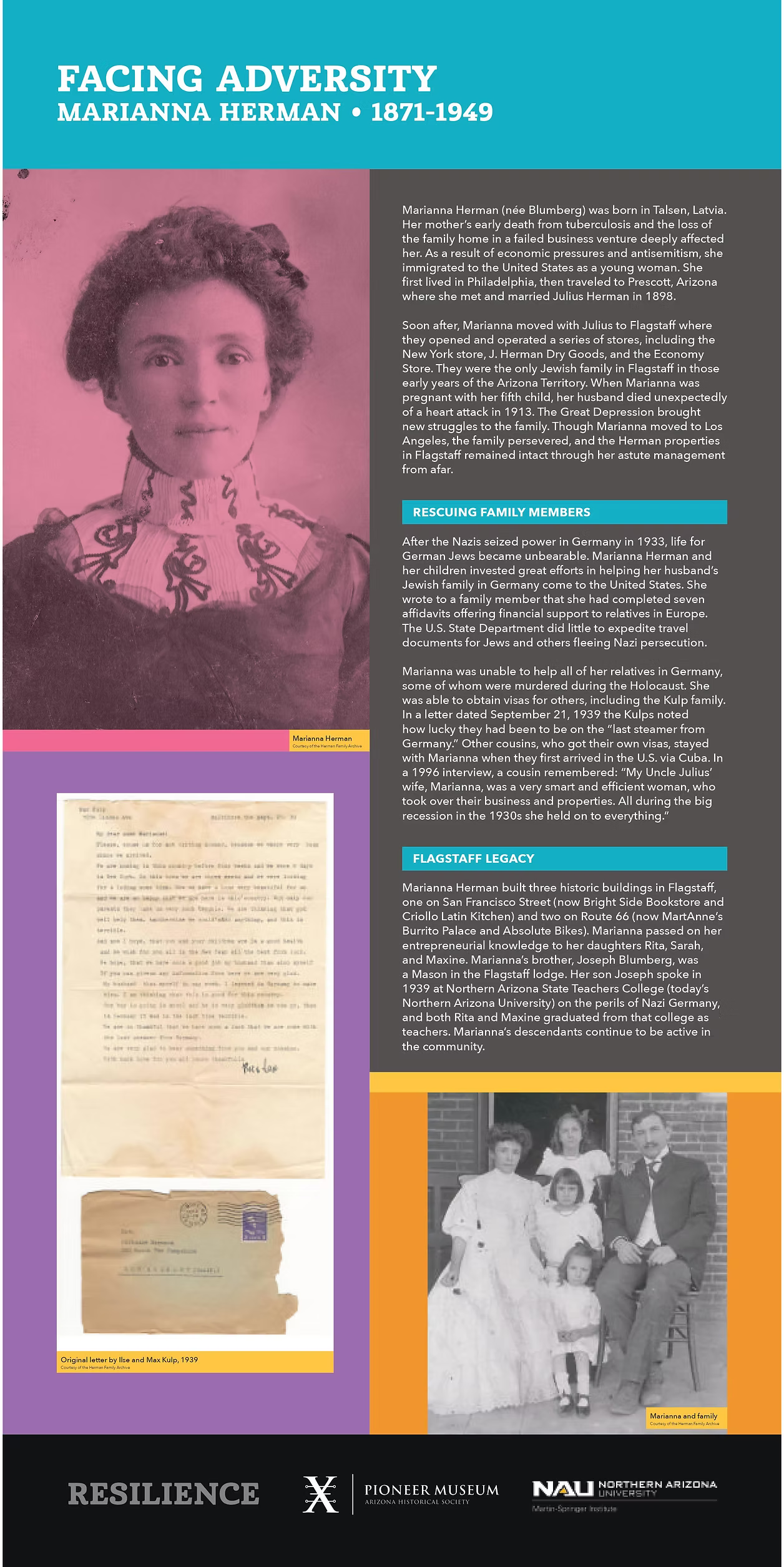
Facing Adversity
Marianna Herman
1971 - 1949
Marianna Herman (née Blumberg) was born in Talsen, Latvia. Her mother’s early death from tuberculosis and the loss of her family home in a failed business venture deeply affected her. As a result of economic pressures and antisemitism, she immigrated to the United States as a young woman. She first lived in Philadelphia, then traveled to Prescott, Arizona where she met and married Julius Herman in 1898.
Soon after, Marianna moved with Julius to Flagstaff where they opened and operated a series of stores including the New York Store, J. Herman Dry Goods, and the Economy Store. They were the only Jewish family in Flagstaff in those early years of the Arizona territory. When Marianna was pregnant with her fifth child, her husband died unexpectedly of a heart attack. It was 1913.
The Great Depression brought new struggles to the family. Though Marianna moved to Los Angeles, the family persevered, and the Herman properties in Flagstaff remained intact through her astute management from afar.
RESCUING FAMILY MEMBERS
After the Nazis seized power in Germany in 1933, life for German Jews became unbearable. Marianna Herman and her children invested great efforts in helping her husband’s Jewish family in Germany come to the United States. She wrote to a family member that she had completed seven affidavits offering financial support to relatives in Europe. The U.S. State Department did little to expedite travel documents for Jews and others fleeing Nazi persecution.
Marianna was unable to help all of her relatives in Germany, some of whom were murdered during the Holocaust. She was able to obtain visas for others, including the Kulp family. In a letter dated September 21, 1939, the Kulps noted how lucky they had been to be on the, “last steamer from Germany.” Other cousins, who got their own visas, stayed with Marianna when they first arrived in the U.S via Cuba. In a 1996 interview, a cousin remembered: “My Uncle Julius’s wife, Marianna, was a very smart and efficient woman who took over their business and properties. All during the big recession in the 1930’s she held on to everything.”
FLAGSTAFF LEGACY
Marianna Herman built three historic buildings in Flagstaff, one on San Francisco Street (now Bright Side Bookstore and Criollo Latin Kitchen) and two on Route 66 (now Martanne’s Burrito Palace and Absolute Bikes). Marianna passed on her entrepreneurial knowledge to her daughters Rita, Sarah, and Maxine. Marianna’s brother, Joseph Blumberg, was a Mason in the Flagstaff lodge. Her son, Joseph, spoke in 1939 at Northern Arizona State Teacher College (today’s Northern Arizona University) on the perils of Nazi Germany, and both Rita and Maxine graduated from that college as teachers. Marianna’s descendants continue to be active in the community.
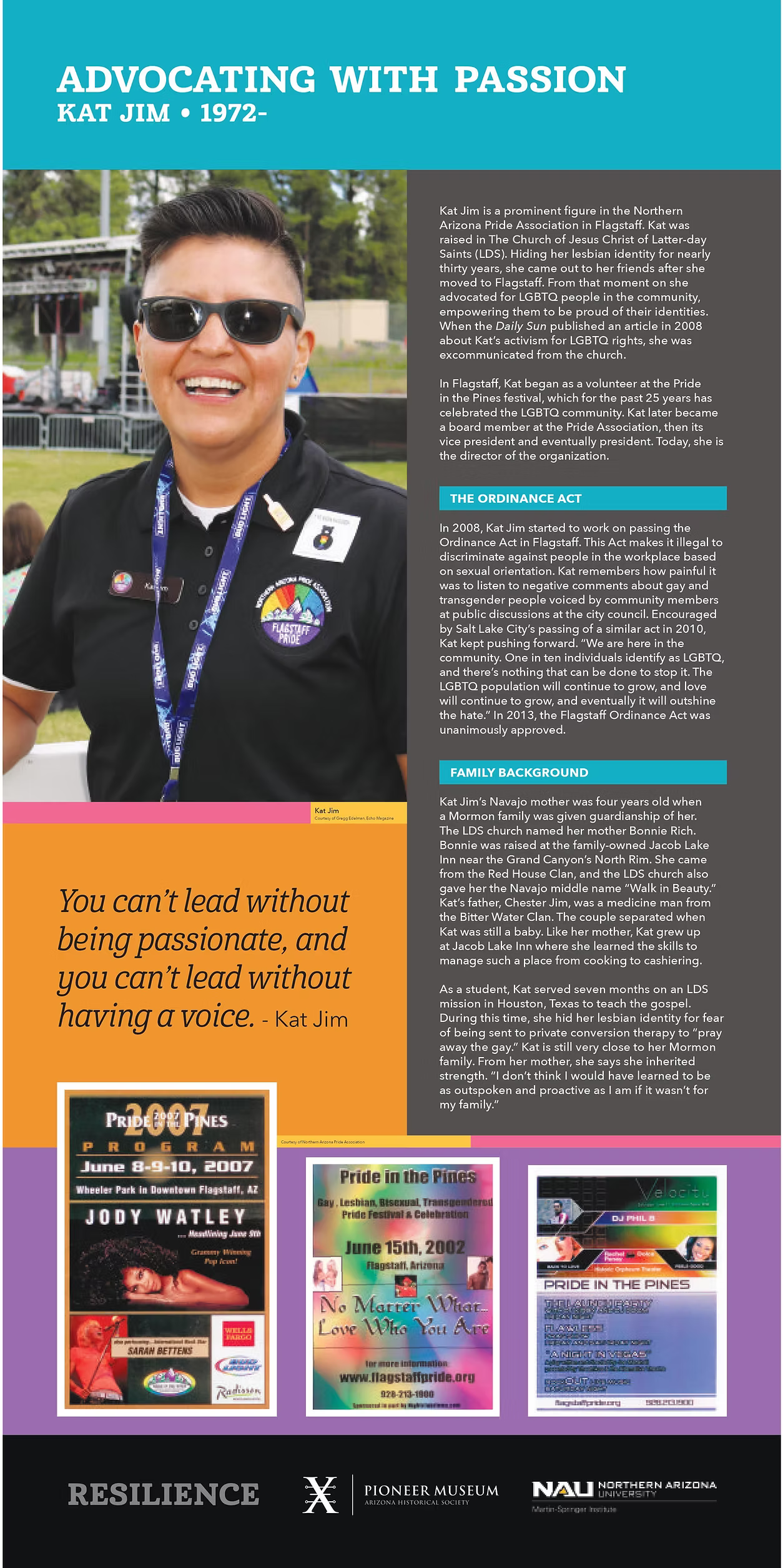
Advocating with Passion
Katt Jim
1972 -
Katt Jim was a prominent figure in the Northern Arizona Pride Association in Flagstaff in the late 2010’s. Katt Jim is Two Spirit. They are no longer part of Flagstaff’s Pride organization, but continue to be active in the movement for LGBTQIA rights.
Katt was raised in The Church of Jesus Christ of Latter-Day Saints (LDS). Hiding their lesbian identity for nearly thirty years, they came out to their friends after they moved to Flagstaff.
From that moment on they advocated for LGBTQ people in the community, empowering them to be proud of their identities. When the Daily Sun published an article in 2008 about Katt’s activism for LGBTQ rights, they were excommunicated from the church.
In Flagstaff, Katt began as a volunteer at the Pride in the Pines Festival, which had been celebrating the Flagstaff queer community for 25 years at the time this exhibit was created in 2019. Katt later became a board member at the Pride Association, then its Vice President and eventually president and director of the organization.
THE ORDINANCE ACT
In 2008, Katt Jim started to work on passing the Ordinance Act in Flagstaff. This Act makes it illegal to discriminate against people in the workplace based on sexual orientation. Katt remembers how painful it was to listen to negative comments about gay and transgender people voiced by community members at public discussions at the city council. Encouraged by Salt Lake City’s passing of a similar act in 2010 Katt kept pushing forward. “ We are here in the community. One in ten individuals identify as LGBTQ, and there’s nothing that can be done to stop it. The LGBTQ population will continue to grow, and love will continue to grow, and eventually it will outshine the hate.” In 2013, the Flagstaff Ordinance Act was unanimously approved.
FAMILY BACKGROUND
Katt’s Navajo mother was four years old when a Mormon family was given guardianship of her. The LDS church named her mother Bonnie Rich. Bonnie was raised at the family-owned Jacob Lake Inn near Grand Canyon’s North Rim. She came from the Red House Clan and the LDS church also gave her the Navajo middle name, “Walk in Beauty.” Katt’s father, Chester Jim, was a medicine man from the Bitter Water Clan. The couple separated when Katt was still a baby. Like their mother, Kat grew up at Jacob Lake Inn where she learned the skills to manage such a place from cooking to cashiering.
As a student, Katt served seven months on an LDS mission in Houston, Texas to teach the gospel. During this time, they hid their lesbian identity for fear of being sent to private conversion therapy to ‘pray away the gay’. Kat is still very close to their Mormon family. From their mother, they say they inherited strength. “I don’t think I would have learned to be as outspoken and proactive as I am if it wasn’t for my family.”
QUOTE FROM KATT
“You can’t lead without being passionate, and you can’t lead without a voice.”
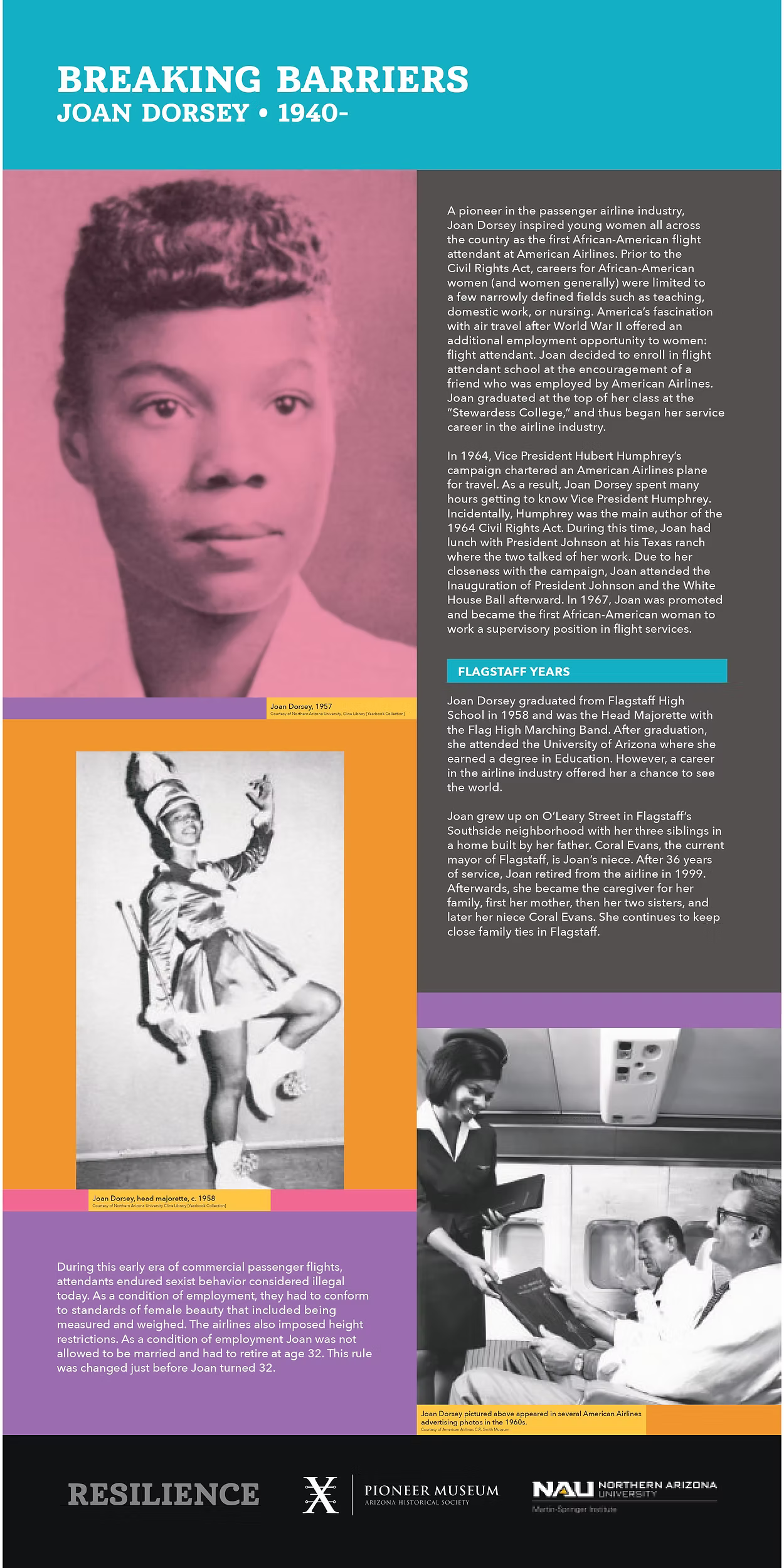
Breaking Barriers
Joan Dorsey
1940 -
A pioneer in the passenger airline industry, Joan Dorsey inspired young women all across the country as the first African-American flight attendant at American Airlines.
Prior to the Civil Rights Act, careers for African-American women (and women generally) were limited to a few narrowly defined fields such as teaching, domestic work, or nursing. America’s fascination with air travel after World War II offered an additional employment opportunity to women: flight attendant.
Joan decided to enroll in flight attendant school at the encouragement of a friend who was employed by American Airlines. Joan graduated at the top of her class at the “Stewardess College,” and thus began her service career in the airline industry.
In 1964, Vice President Hubert Humphrey’s campaign chartered an American Airlines plane for travel. As a result, Joan Dorsey spent many hours getting to know Vice President Humphrey. Incidentally, Humphrey was the main author of the 1964 Civil Rights Act.
During this time, Joan had lunch with President Johnson at his Texas ranch where the two talked of her work. Due to her closeness with the campaign, Joan attended the inauguration of President Johnson and the White House Ball afterward.
In 1967, Joan was promoted and became the first African-American woman to work a supervisory position in flight services.
FLAGSTAFF YEARS
Joan Dorsey graduated from Flagstaff High School in 1958 and was the head majorette with the Flag High Marching Band. After graduation, she attended the university of Arizona where she earned a degree in Education. However, a career in the airline industry offered her a chance to see the world.
Joan grew up on O’Leary Street in Flagstaff’s Southside neighborhood with her three siblings in a home built by her father. Coral Evans, the current mayor of Flagstaff, is Joan’s niece. After 36 years of service, Joan retired from the airline in 1999. Afterwards she became the caregiver for her family, first her mother, then her two sisters, and later her niece ,Coral Evans. She continues to keep close family ties in Flagstaff.
During this early era of commercial passenger flights, attendants endured sexist behavior considered illegal today. As a condition of employment, they had to conform to standards of female beauty that included being measured and weighed. The airlines also imposed height restrictions. As a condition of employment, Joan was not allowed to be married and had to retire at age 32. This was changed just before Joan turned 32.
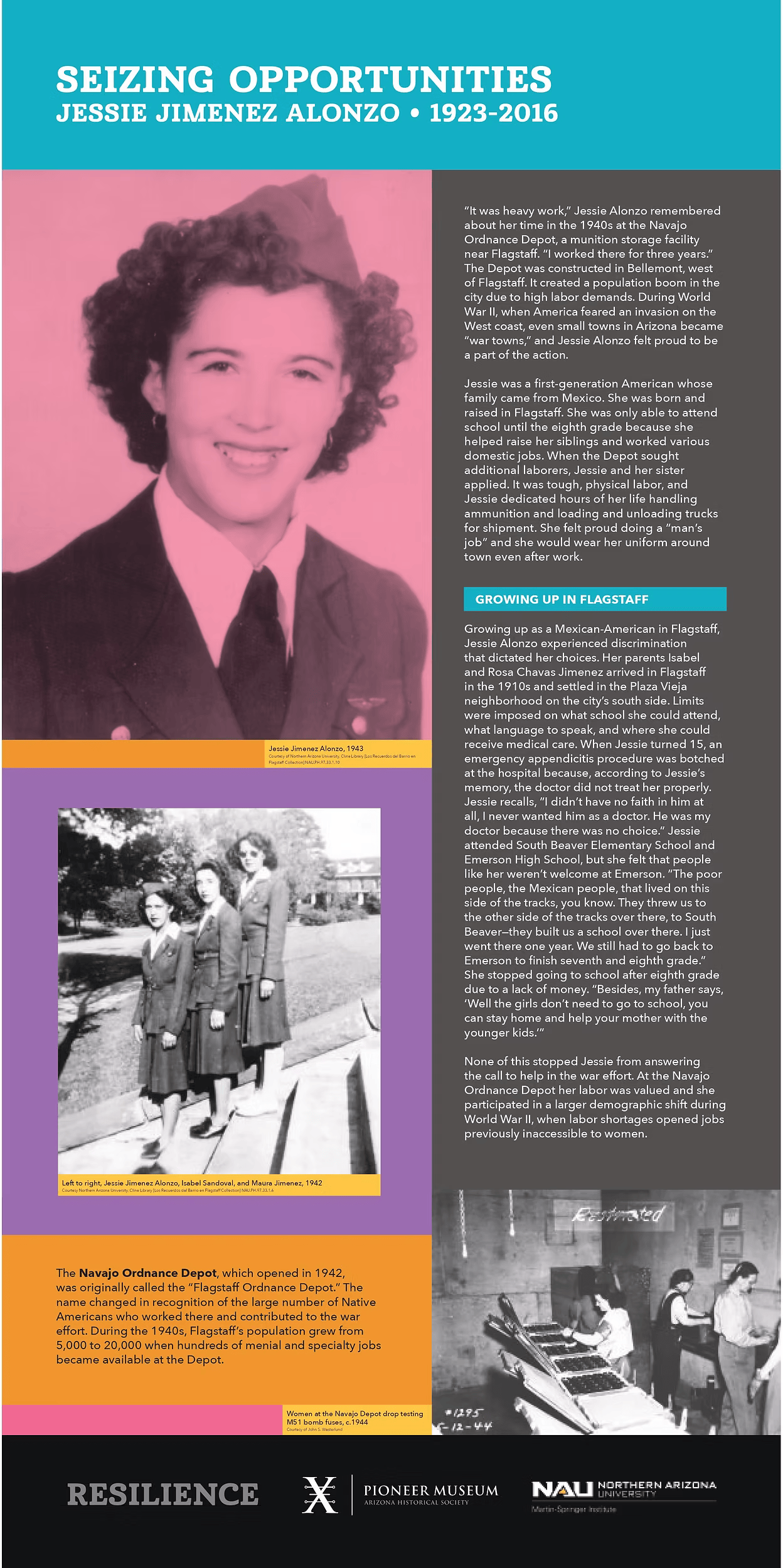
Seizing Opportunities
Jessie Jimenez Alonzo
1923 - 2016
“It was heavy work,” Jessie Alonzo remembered about her time in the 1940’s at the Navajo Ordnance Depot, a munition storage facility near Flagstaff. “I worked there for three years.” The Depot was constructed in Bellemont, west of Flagstaff. It created a population boom in the city due to high labor demands. During World War II, when America feared an invasion on the West coast, even small towns in Arizona became ”war towns” and Jessie Alonzo felt proud to be a part of the action.
Jessie was a first generation American who’s family came from Mexico. She was born and raised in Flagstaff. She was only able to attend school until the eighth grade because she helped raise her siblings and worked various domestic jobs.
When the Depot sought additional laborers, Jessie and her sister applied. It was tough, physical labor, and Jessie dedicated hours of her life to handling ammunition and loading and unloading trucks for shipment. She felt proud of doing a “man’s job” and she would wear her uniform around town even after work.
GROWING UP IN FLAGSTAFF
Growing up as a Mexican-American in Flagstaff, Jessie Alonzo experienced discrimination that dictated her choices. Her parents, Isabel and Rosa Chavas Jimenez, arrived in Flagstaff in the 1910’s and settled in the Plaza Vieja neighborhood on the city’s south side. Limits were imposed on what school she could attend, what language to speak, and where she could receive medical care.
When Jessie turned 15, an emergency appendicitis procedure was botched at the hospital because, according to Jessie’s memory, the doctor did not treat her properly. Jessie recalls, “I didn’t have no faith in him at all. I never wanted him as a doctor. He was my doctor because there was no choice.” Jessie attended South Beaver Elementary School and Emerson High School, but she felt that people like her weren’t welcome at Emerson. “The poor people, the Mexican people that lived on this side of the tracks, you know. They threw us to the other side of the tracks over there. I just went there one year. We still had to go back to Emerson to finish 7th and 8th grade.”
Jessie stopped going to school after eighth grade due to lack of money. “Besides, my father says, ‘well, girls don’t need to go to school, you can stay home and help your mother with the younger kids.’”
None of this stopped Jessie from answering the call to help in the war effort. At the Navajo Ordnance Depot her labor was valued and she participated in a larger demographic shift during World War II, when labor shortages opened jobs previously inaccessible to women.
The Depot
The Navajo Ordnance Depot, which opened in 1942, was originally called the “Flagstaff Ordnance Depot.” The name changed in recognition of the large number of Native Americans who worked there and contributed to the war effort. During the 1940’s, Flagstaff’s population grew from 5,000 to 20,000 when hundreds of menial and specialty jobs became available at the Depot.
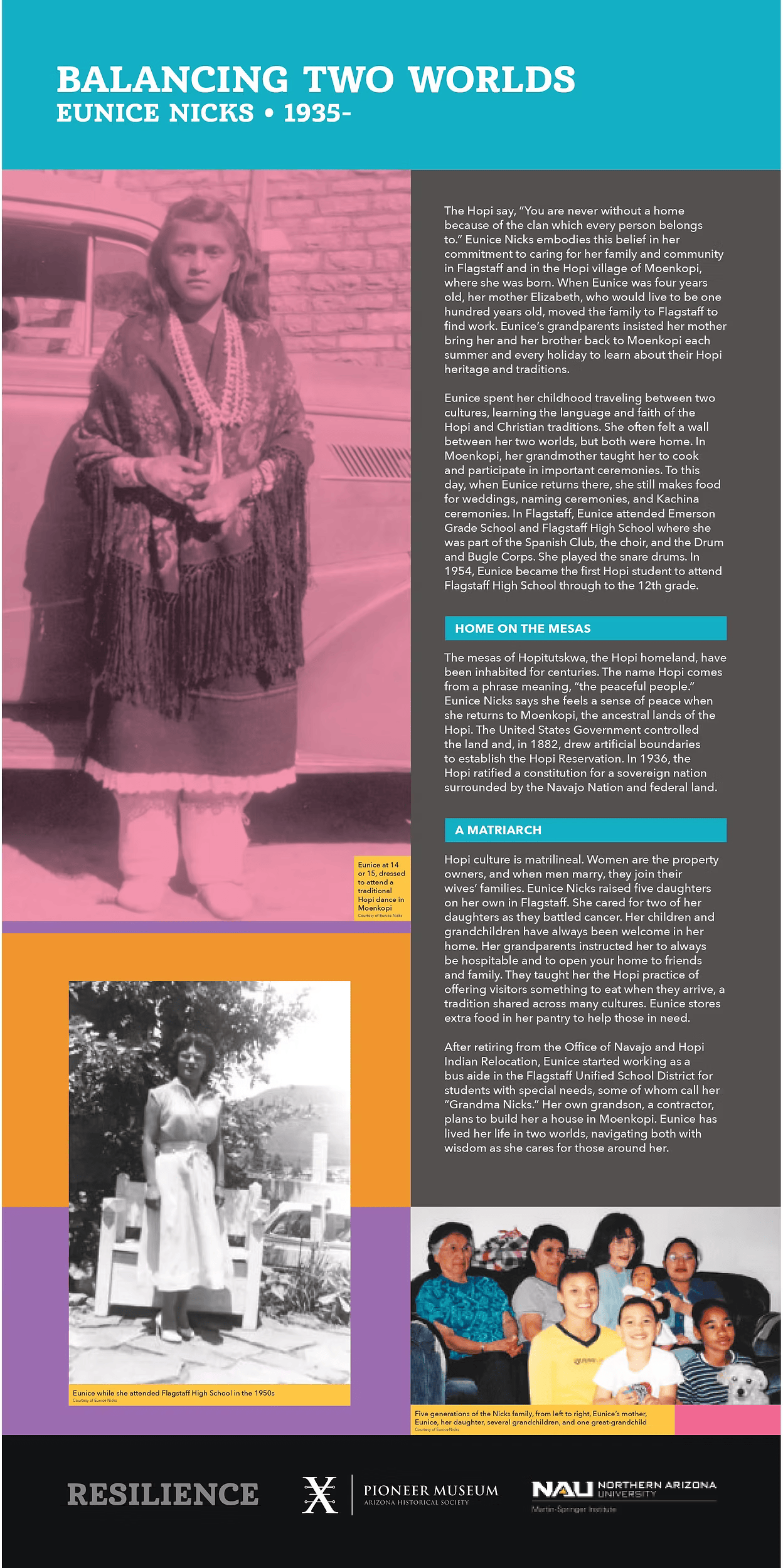
Balancing Two Worlds
Eunice Nicks
1935-
The Hopi say, “You are never without a home because of the clan which every person belongs to.” Eunice Nicks embodies this belief in her commitment to caring for her family and community in Flagstaff and in the Hopi village of Moenkopi, where she was born. When Eunice was four years old, her mother, Elizabeth, who would live to be one hundred years old, moved the family to Flagstaff to find work. Eunice’s grandparents insisted her mother bring her and her brother back to Moenkopi each summer and every holiday to learn about their Hopi heritage and traditions.
Eunice spent her childhood traveling between two cultures, learning the language and faith of the Hopi and Christian traditions. She often felt a wall between her two worlds, but both were home. In Moenkopi, her grandmother taught her to cook and participate in important ceremonies. To this day, when Eunice returns there, she still makes food for weddings, naming ceremonies, and Kachina ceremonies. In Flagstaff, Eunice attended Emerson Grade School and Flagstaff High School where she was part of the Spanish Club, the choir, and the Drum and Bugle Corps. She played the snare drums. In 1954, Eunice became the first Hopi student to attend Flagstaff High School through 12th grade.
HOME ON THE MESAS
The mesas of Hopitutskwa, the Hopi homeland, have been inhabited for centuries. The name Hopi comes from a phrase meaning, “the peaceful people.” Eunice Nicks says she feel a sense of peace when she returns to Moenkopi, the ancestral land of the Hopi. The United States Government controlled the land and, in 1882, drew artificial boundaries to establish the Hopi Reservation. In 1936, the Hopi ratified a constitution for a sovereign nation surrounded by the Navajo nation and federal land.
A MATRIARCH
Hopi culture is matrilineal. Women are the property owners, and when men marry, they join their wives’ families. Eunice raised five daughters on her own in Flagstaff. She cared for two of her daughters as they battled cancer. Her children and her grandchildren have always been welcome in her home. Her grandparents instructed her to always be hospitable and to open your home to friends and family. They taught her the Hopi practice of offering visitors something to eat when they arrive, a tradition shared across many cultures. Eunice stores extra food in her pantry to help those in need.
After retiring form the office of Navajo and Hopi Indian Relocation, Eunice started working as a bus aide in the Flagstaff Unified School District for students with special needs, some of whom call her, “Grandma Nicks.” Her own grandson, a contractor, plans to build her a house in Moenkopi. Eunice has lived her whole life in two worlds, navigating both with wisdom as she cares for those around her.
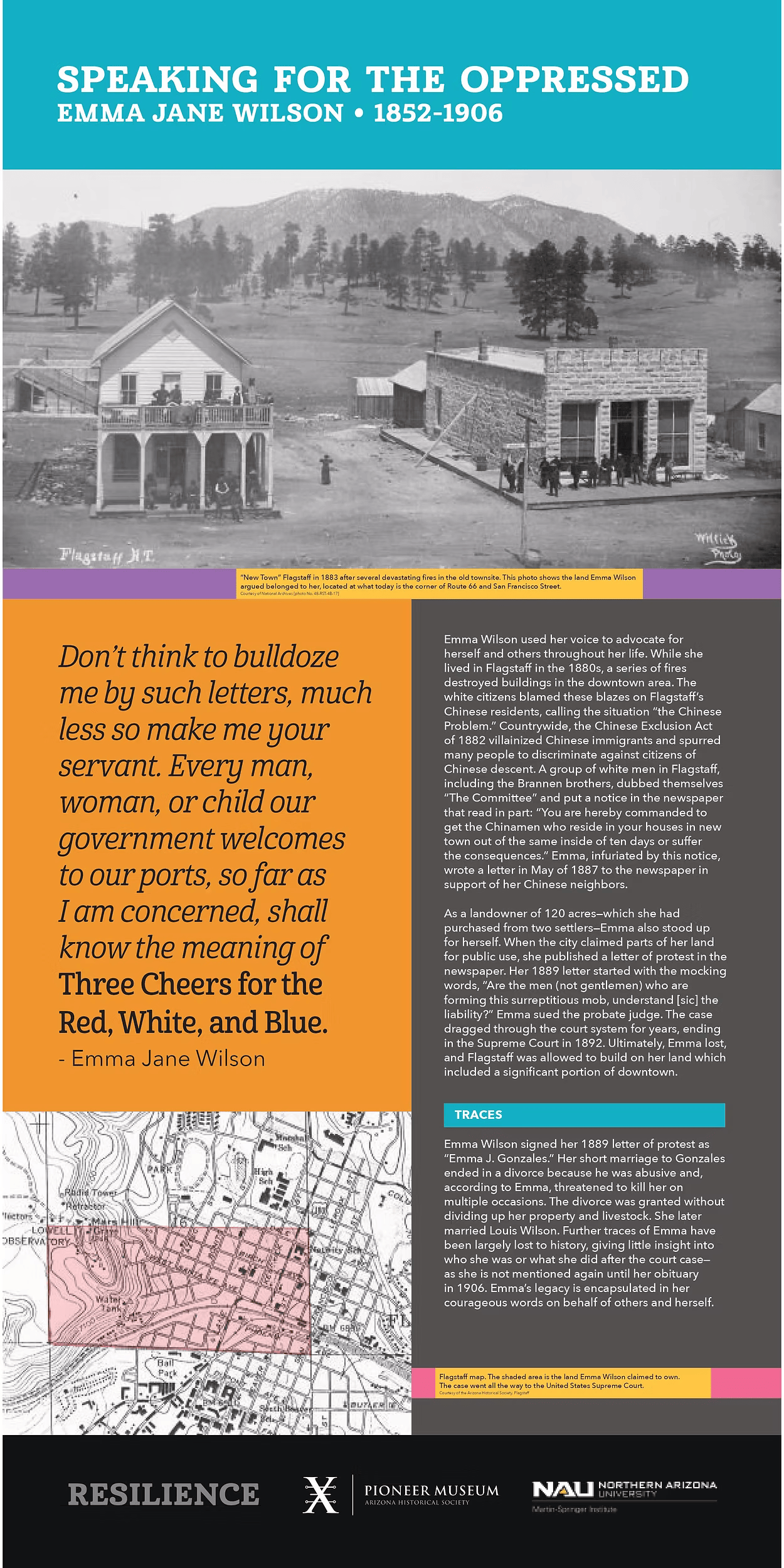
Speaking for the Opressed
Emma Jane Wilson
1852 - 1906
Emma Wilson used her voice to advocate for herself and others throughout her life. While she lived in Flagstaff in the 1880’s, a series of fires destroyed buildings in the downtown area. The white citizens blamed these blazes on Flagstaff’s Chinese residents, calling the situation, “the Chinese Problem.”
Countrywide, the Chinese Exclusion Act of 1882 villainized Chinese immigrants and spurred many people to discriminate against citizens of Chinese descent.
A group of white men in Flagstaff, including the Brannen brothers, dubbed themselves, “The Committee,” and put a notice in the newspaper that read in part: “You are hereby commanded to get the Chinamen who reside in your houses in new town out of the same inside of ten days or suffer the consequences.”
Emma, infuriated by this notice, wrote a letter in May of 1887 to the newspaper in support of her Chinese neighbors.
As a landowner of 120 acres—which she had purchased from two settlers—Emma also stood up for herself.
When the city claimed parts of her land for public use, she published a letter of protest in the newspaper. Her 1889 letter started with the mocking words, “Are the men (not gentlemen) who are forming this surreptitious mob, understand[sic] the liability?”
Emma sued the probate judge.
The case dragged through the court system for years, ending in the Supreme Court in 1892. Ultimately, Emma lost, and Flagstaff was allowed to build on her land which included a significant portion of downtown.
TRACES
Emma Wilson signed her 1989 letter of protest as, “Emma J. Gonzales.” Her short marriage to Gonzales ended in a divorce because he was abusive and, according to Emma, threatened to kill her on multiple occasions. The divorce was granted without dividing up her property and livestock.
She later married Louis Wilson. Further traces of Emma have been largely lost to history, giving little insight into who she was or what she did after the court case—as she is not mentioned again until her obituary in 1906. Emma’s legacy is encapsulated in her courageous words on behalf of others and herself.
Quote from Emma:
“Don’t think to bulldoze me by such letters, much less so make me your servant. Every man, woman, or child our government welcomes to our ports, so far as I am concerned, shall know the meaning of Three Cheers for the Red, White, and Blue.”