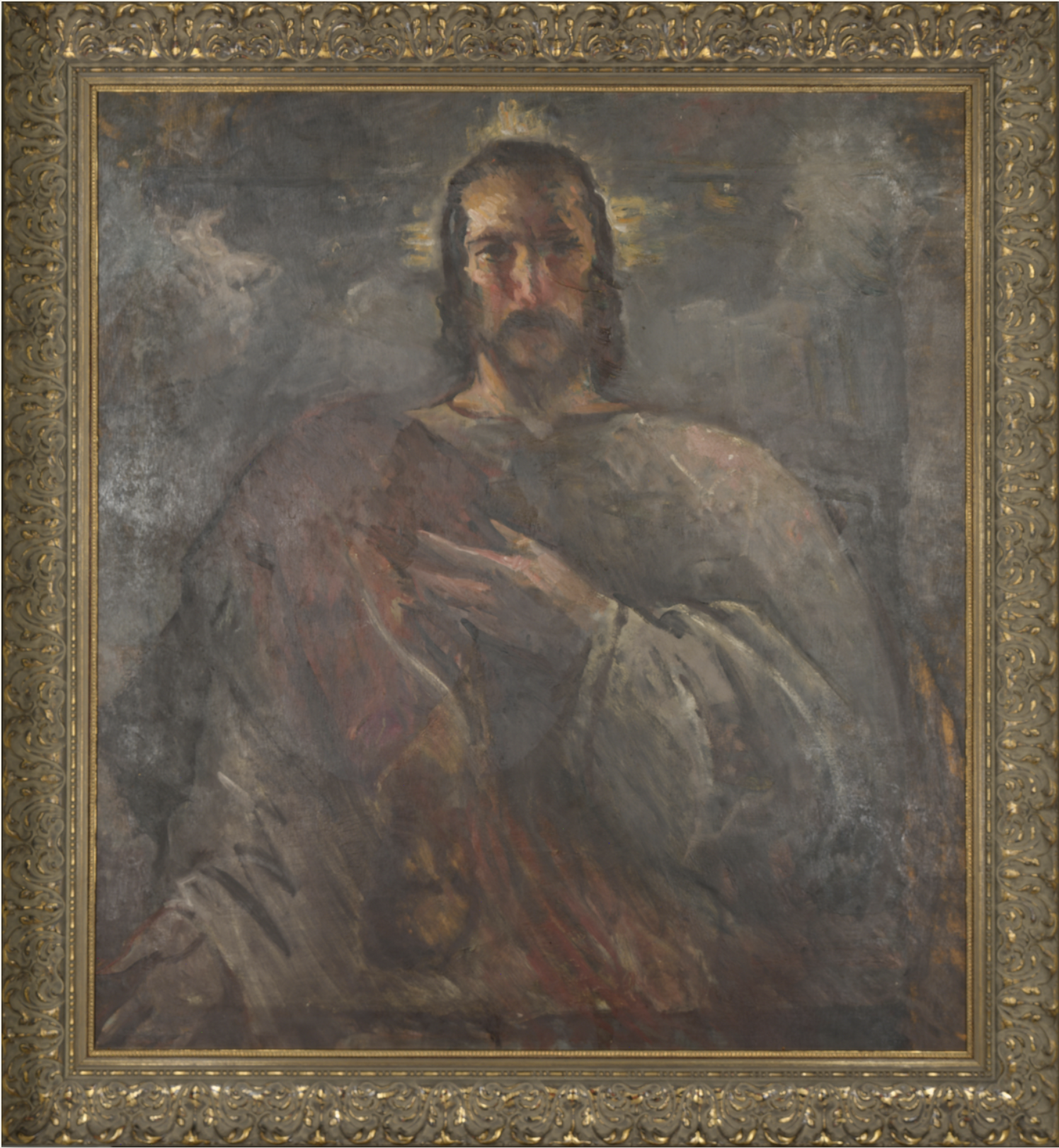
Cristo
Gino Parin (1876-1944)
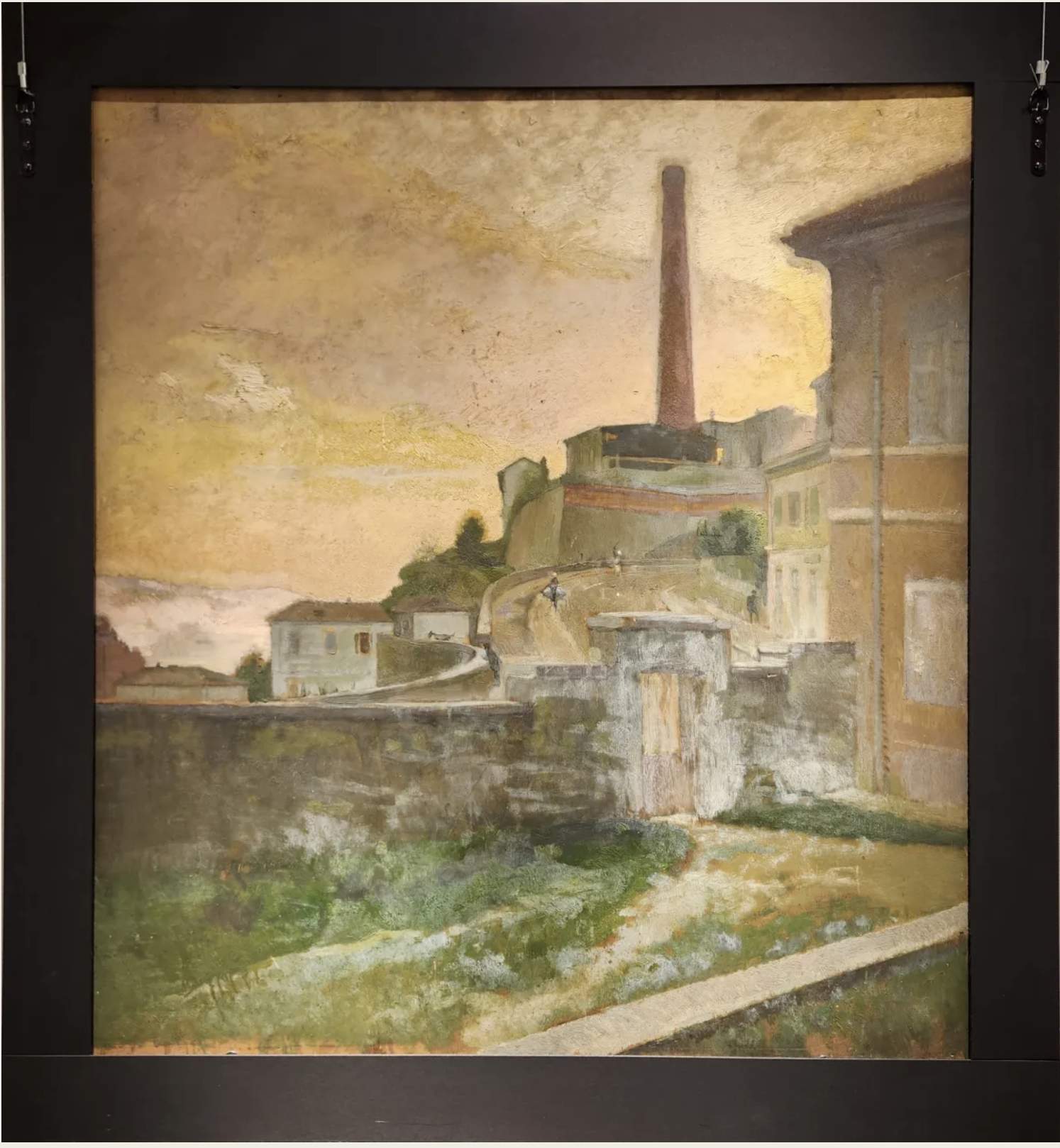
Cristo (Christ) and View of Trieste with the Civic Crematorium
Oil on plywood
ca. 1942
Collection of Necki Springer, Cottonwood, Arizona
Photographs courtesy of David Shaffer
Parin’s Cristo, which he neither signed nor dated, currently hangs in the sacristy of the Immaculate Conception Catholic Church in Cottonwood, Arizona. Using a subdued color palette, the artist depicted Jesus, whose features bear an eerie semblance to his own, from the waist up. A red brownish mantle flows down from his right shoulder over a loosely fitted, dirt-white robe. At first sight, there is not much to see. But upon closer inspection, it is easy to make out a variety of images that the artist hid in the painting.
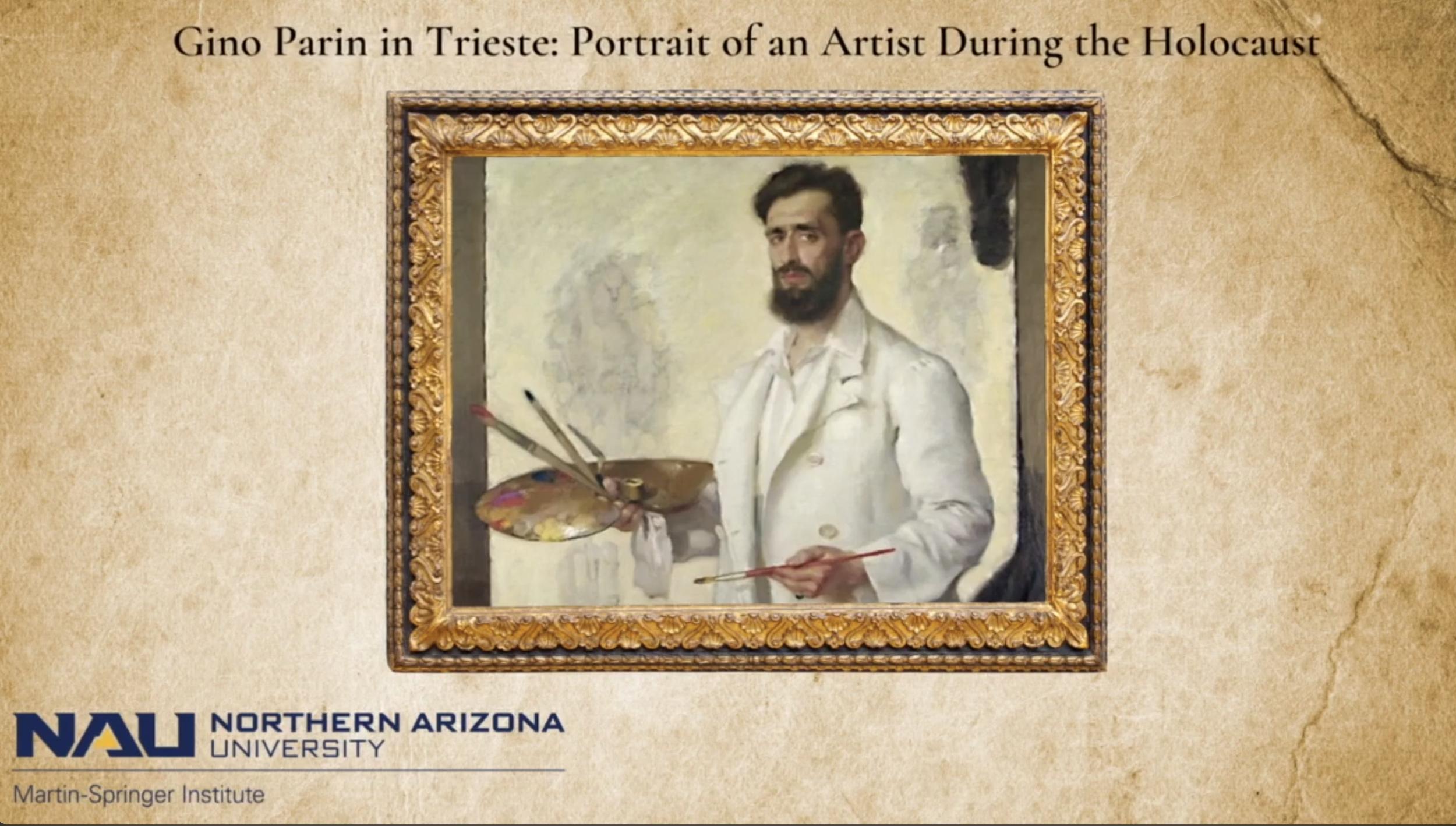
Cristo might be one of the last paintings Parin made. A pamphlet dating to 1964, the twentieth anniversary of Parin’s death, includes a self-portrait of the artist and a short reflection written by Johannes Dittrich, the rector in charge of the German-speaking Catholic church in Trieste, who had arrived in the city in 1938. Parin and Magda Springer were both known to Dittrich, who further mentions that Parin had been commissioned to paint a picture of Christ for his church. He also notes that the artist was not able to finish it because he was arrested by the Gestapo in April of 1944 and accused of “financial misconduct.” In addition, Dittrich writes that an oil painting showing the full body of Christ rather than just his torso and head, which the artist signed and dated (GINO PARIN/A.D. MCMXLII), was a study for this commission. After the end of World War II, in March of 1946, the city displayed this full-bodied Cristo as part of an exhibition in honor of Parin’s work. At that time, a local art critic and fellow painter, Giuseppe Matteo Campitelli, also characterized it as a sketch, presumably for the city’s German-speaking Catholic Church. It is therefore possible that the Cottonwood Cristo was a preparatory study that Magda took possession of after Parin’s arrest.
Lending credence to this theory is the presence of a second painting on its backside – an idyllic cityscape of uncertain date featuring Trieste’s public crematorium (a structure that should not be correlated with the crematory built by the Nazis at the Risiera di San Sabba transit-and-prison camp, as the latter only started operating in 1944 to burn the bodies of the political and Jewish prisoners who died there). Parin painted many landscapes throughout his career, and the fact that there are two paintings on the back and front of a single piece of modestly sized plywood suggests that the Cottonwood Cristo was painted during his final period (1938 – 1944). This is when he was no longer able to exhibit publicly because he was considered “racially” Jewish, first by Italy’s fascist regime and then by the German Nazi occupiers of Trieste. Nevertheless, the painting and several surviving portraits indicate that Parin continued to practice his craft until his arrest.